

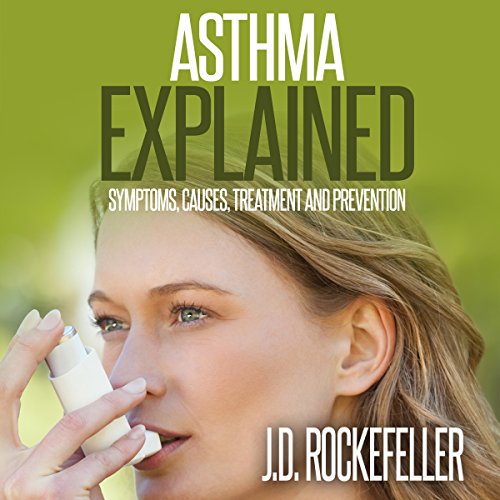
Asthma Explained
Failed to add items
Add to basket failed.
Add to wishlist failed.
Remove from wishlist failed.
Adding to library failed
Follow podcast failed
Unfollow podcast failed
Get 30 days of Standard free

Asthma Explained
Buy Now for £4.49
-
Narrated by:
-
James Colby Green
-
By:
-
J.D. Rockefeller
Asthma is classified as a chronic lung condition that narrows and inflames the airways. The disease causes wheezing when you breathe, shortness of breath, coughing, and chest tightness. The coughing normally occurs early in the morning or at night. Asthma affects people from all walks of life, including children, men, and women, but most begin to experience it during childhood. In the US over 25 million people suffer from asthma, and seven million of these are children.
In order to understand the prevalence of asthma, it is important to know how the airways function. Airways are tubes that transport air into and out of the lungs. Victims of asthma are characterized by having inflamed airways. This inflammation makes the airways become swollen and very sensitive, and it also makes them react very strongly to different inhaled elements.
When the airways react to inhaled substances, muscles around them begin to tighten. This constricts the airways and causes them to become narrow, which in turn results in less air flow into and out of the lungs. The swelling can become worse and constrict the airways narrower. The cells in the airways may produce more mucus than normal, and this sticky, thick mucus may further make the airways narrower. This sequential reaction may result in people experiencing asthma symptoms. These symptoms may occur every time airways become inflamed.
©2015 J.D. Rockefeller (P)2015 J.D. Rockefeller