Political Beats cover art

Political Beats

Political Beats

By: National Review
Listen for free

Season's Savings | £0.99/mo for 3 months

£5.99/mo after 3 months - terms apply. Cancel monthly
Scot Bertram and Jeff Blehar discuss ask guests from the world of politics about their musical passions.National Review Music
Episodes
  • Episode 161: The Cure, Pt. I
    Oct 20 2026

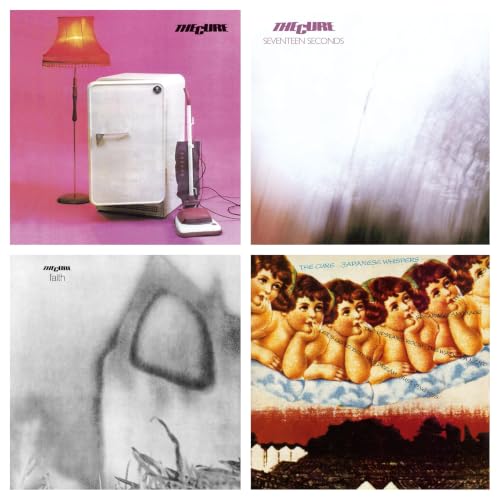
    Scot and Jeff discuss the first part of The Cure’s career (1978-1984) with Derek Wilczynski.

    Introducing the Band:

    Your hosts Scot Bertram (@ScotBertram) and Jeff Blehar (@EsotericCD) are joined by guest Derek Wilczynski. Derek is a Michigan attorney with a trial practice, as well as treasurer for the Macomb County Republican Party.

    Derek’s Musical Pick: The Cure

    It’s time to paint your fingernails black and adopt your bleakest attitude as we dive into the first part of the story of post-punk’s longest-running and most influential band, The Cure. The Cure were never the loudest or most aggressively weird group of the British late ‘70s and early ‘80s – and they certainly weren’t the most musically adept. (Their original drummer was nicknamed “Lol,” almost as if they knew.) But they were always there, off in their own corner, sometimes held together as a musical proposition by little more than spit, chewing gum, and the songwriting talent and sheer force of will of Robert Smith, their lead singer and songwriter.

    In their early post-punk years, The Cure – before they hit enduring stardom in America in the mid-1980s with the sheaf of poppy, upbeat gems they’re now synonymous with – were a magnificently surly, forbidding beast, a barebones sound created by three (occasionally four) musical primitives using their technical limitations to create the minimalist bluntness we forever associate with “goth” as a subgenre. But Smith was never a style poseur – he was an incredibly gifted songwriter and lyricist, mining this particular dark ore into the depths of the underground with albums like Seventeen Seconds, Faith, and the legendary (and, in our opinion, overwrought!) Pornography.

    Then, he turned into a pop writer! For a band as famous and long-lasting as Robert Smith’s, is it strange to realize that The Cure were essentially two (and maybe three) separate groups, at least conceptually. Here we address the first group and embark upon a glorious, long day’s journey into night. Dawn is just around the corner by 1984.


    Hosted by Simplecast, an AdsWizz company. See pcm.adswizz.com for information about our collection and use of personal data for advertising.

    Show More Show Less
    2 hrs and 2 mins
  • Episode 160: Eli Lake / Steely Dan
    Aug 20 2026

    Introducing the Band:
    Your hosts Scot Bertram (@ScotBertram) and Jeff Blehar (@EsotericCD) with guest Eli Lake. Eli is a columnist for The Free Press, contributing editor at Commentary, and host of Breaking History. You can follow him on Twitter/x @EliLake.

    Eli’s Music Pick: Steely Dan
    In what is likely the last of our past episodes to be completely re-recorded, we present a totally new edition of our look at the music and career of Steely Dan. Jeff long has despised the sound of his microphone on the original show (our version of a Katy Lied-esque mishap), which also was recorded in a back-up studio. It makes sense to get something on tape that will stand the test of time.

    There may not be a more unlikely story in rock history than Steely Dan, more specifically the braintrust of Donald Fagen and Walter Becker. Michael McDonald, who provided backing vocals for the band later in its career, wrote that Fagen had the "physique of an 80-year-old woman" and Becker gave off the distinct vibe of a "lab technician working on some nefarious government experiment." These two guys, who famously didn't even like the idea of being in a conventional rock band, somehow became one of the most distinctive and enduring acts of the 1970s. They took the sounds of jazz, R&B, soul, blues, pop, and rock, ran them through a filter of studio perfectionism and darkly funny songwriting, and came out with something that sounded like nobody else. And somehow, against all odds, some of the most musically complicated songs of their era became radio staples.

    The Steely Dan story is also a story of constant reinvention. From the sly pop-rock of Can't Buy a Thrill and Countdown to Ecstasy, through the increasingly ambitious Pretzel Logic, Katy Lied, and The Royal Scam, Becker and Fagen gradually turned the recording studio into their own musical laboratory. Then came Aja, the masterpiece that may be the ultimate expression of their obsession with precision, groove, and impeccable musicianship. The term “Yacht Rock” might as well have been born right then and there. Gaucho pushed that approach even further, even as the band's perfectionism and internal tensions reached a breaking point.

    We dig into the music, the personalities, the bizarre characters, the legendary studio sessions, and the songs that make Steely Dan so endlessly rewarding. Because beneath all the perfectionism and complexity, Steely Dan always understood one fundamental thing: A great song still needs a great groove.


    Hosted by Simplecast, an AdsWizz company. See pcm.adswizz.com for information about our collection and use of personal data for advertising.

    Show More Show Less
    3 hrs and 17 mins
  • Episode 159: Nic Rowan / Sleater-Kinney
    Jul 14 2026

    Scot and Jeff discuss Sleater-Kinney with Nic Rowan.

    Introducing the Band:

    Your hosts Scot Bertram (@ScotBertram) and Jeff Blehar (@EsotericCD) with guest Nic Rowan. Nic is managing editor of The Lamp, a Catholic literary journal. You can follow him on Twitter/x @NicXTempore.

    Nic’s Music Pick: Sleater-Kinney

    When people talk about the greatest American rock bands of the past 30 years, the conversation usually starts in familiar places (we might say Spoon around these parts). But sooner or later, it ought to arrive at a discussion of Sleater-Kinney. The band, named after Sleater Kinney Road in Washington near Interstate 5, formed in the Pacific Northwest during the explosion of the riot grrrl movement. Carrie Brownstein, Corin Tucker, and, eventually, Janet Weiss built a sound that was fiercely intelligent without being pretentious and musically adventurous without ever losing sight of the hook. Their records are packed with jagged guitars, knotty rhythms, and thrilling vocal interplay, all delivered with an urgency that never feels manufactured.

    Part of what makes Sleater-Kinney such a compelling subject is that they're difficult to pigeonhole. They're often introduced first as an important feminist band, or a cornerstone of riot grrrl, or a political band, and all of those descriptions contain some truth. But they can also obscure the bigger picture. Strip away the labels, and what's left is an extraordinary rock band, one with a distinctive musical language and an uncanny ability to make tension sound exhilarating.

    Over the course of a remarkable run, the band continually reinvented itself without abandoning its identity. Dig Me Out and One Beat get universal praise on this show, while there's great debate over the generally well-regarded The Woods. And what to make of the comeback after a decade away? We trace that entire journey and discuss why Sleater-Kinney remains one of the essential bands of modern American rock.

    If you know them, you know why they matter. If you don’t, you’re about to find out. Join us for a deep look at the music and career of Sleater-Kinney.


    Hosted by Simplecast, an AdsWizz company. See pcm.adswizz.com for information about our collection and use of personal data for advertising.

    Show More Show Less
    2 hrs and 45 mins
adbl_web_anon_alc_button_suppression_t1
No reviews yet