• 20-Navigating Difficult Conversations - with Meisha Marshall
    Oct 28 2026
    With Guest Meisha Marshall, Marriage & Relationship CoachSome conversations are hard to start. Others are hard to finish. And sometimes, the conversations we avoid are the very ones that could bring us closer together.After a gray divorce, parents and adult children may carry questions, misunderstandings, and feelings they've never quite found the words to express—even years later.In this episode of Navigating the Gray, Pat and Kimberly welcome marriage and relationship coach Meisha Marshall for a practical, encouraging conversation about having difficult discussions without damaging the relationships we're trying to strengthen.From recognizing unhealthy communication patterns to learning how to express our needs with greater clarity, Meisha shares strategies for turning difficult conversations into opportunities for understanding and connection.In This Episode, We Talk About:Why conversations about divorce can remain difficult years—or decades—laterThe difference between healthy conflict and communication that creates more distanceHow a gentle or "soft startup" can change the direction of a conversationWhy identifying and naming our emotions helps us communicate more clearlyWhat to do when two family members remember the same experience differentlyHow to recognize when it's time to pause a conversation—and how to restart itWhy healing doesn't depend on someone else's acknowledgment or agreementTwo Things Can Be TrueYou can want a closer relationship with someone and still disagree about what happened in the past.You can share your feelings honestly without requiring the other person to see things exactly as you do.And perhaps most importantly, you can continue healing even when someone else isn't ready—or able—to have the conversation you hoped for.Something to Think AboutIs there a conversation you've been avoiding because you're afraid of how the other person might respond?What might change if your goal were simply to be heard and understood, rather than to reach agreement?A Thought Worth Remembering"Hard conversations need to be known." — Meisha MarshallHealthy conflict isn't about winning an argument. It's about creating enough safety and understanding to be honest with one another—even when it's uncomfortable.Resources MentionedEmotion Wheel: A helpful tool for identifying and putting words to feelings before beginning a difficult conversation.Download your copy hereAbout Meisha Marshall: Meisha Marshall is a Family and Relationship coach in Atlanta, GA. She’s always been a champion for loving and committed marriages that keep families knitted together. As they demonstrate what committed love looks like amidst the ups and downs of life, that’s what she wants for her marriage and for every couple she serves. However, growing up with two fathers - a stepdad and a biological father - she didn’t see her biological father that much. And the divorce of her mother and stepdad, after 21 years of marriage, was difficult for the whole family. It is the combination of her training in NLP (neuro-linguistic programming), her desire for healthy family relationships, and her experience of being an adult child of divorce (ACOD) that uniquely equips her to speak to the families of those affected by gray divorce.Meisha's websiteJoin the ConversationHave you found a way to approach a difficult family conversation that made a difference? Or is there one you're still trying to figure out how to begin?We'd love to hear your experience! Use our SpeakPipe link to share your thoughts. Your story may encourage someone else navigating a similar situation.Free ResourcesWhether you're navigating gray divorce yourself or you're an adult child of divorce, we've created free guides to help you move forward with greater clarity and confidence.📘 For Divorced Parents: Post-Gray Divorce Recovery Guide📗 For Adult Children of Divorce: Healing & Relationship GuideNavigating the Gray Live!Ready to see your family story from a new perspective?Join us November 1 for NTG Live!, an experience designed to help divorced parents and adult children discover new perspectives, strengthen relationships, and imagine what's possible in the next chapter.navigatingthegray.online/ntglive
    Show More Show Less
    34 mins
  • NTG Live! What Happens When Both Sides of the Story Come Together?
    Oct 18 2026
    NTG Live! What Happens When Both Sides of the Story Come Together?

    What happens when divorced parents and their adult children have the opportunity to hear the other side of the family story—without blame, judgment, or the pressure to fix everything?

    In this special bonus episode, Pat and Kimberly give you a sneak peek at NTG Live!, our upcoming in-person experience in Decatur, Georgia, on November 1st.

    We're bringing the conversations we've started on the podcast into the same room, creating opportunities for fresh perspectives, meaningful connections, and new possibilities for moving forward.

    Here's what you can look forward to:

    • Honest conversations from both sides of gray divorce
    • Small-group discussions with other divorced parents or adult children
    • A special Rewriting Your Story session with guest Adam Olenn
    • Guided reflection and opportunities for those wonderful "aha!" moments
    • Practical takeaways to help you approach your next chapter with greater clarity and confidence
    • A welcoming community where you can come with someone—or arrive on your own and find people who understand

    Sunday, November 1, 2026 | 1–5 PM

    Holiday Inn Express | Decatur, Georgia

    Bring a family member, a friend, or just yourself! Our special Come Together pricing makes it easier to share the experience with someone important to you.

    Seating is limited, so reserve your place today!

    Questions? Leave them on our Speakpipe

    Register here: https://navigatingthegray.online/ntglive

    Because your family story isn't over. And sometimes, seeing it through another person's eyes opens up possibilities you never imagined.

    Hope and healing are possible, even in the gray.

    Show More Show Less
    16 mins
  • 18-Navigating the Line Between Caring and Carrying
    Oct 14 2026

    When does caring for a parent become carrying their emotional weight?

    After a gray divorce, that line can get surprisingly blurry. Adult children love their parents, understand the family history, and may naturally become a source of support. And parents—often without realizing it—may begin leaning on them more heavily.

    In this episode of Navigating the Gray, Pat and Kimberly explore what happens when adult children become emotional caregivers, how these patterns can develop without anyone intending them to, and how both parents and adult children can create healthier boundaries without sacrificing closeness.

    Because stepping back doesn't have to mean walking away.

    In This Episode
    • Why adult children can naturally become emotional caregivers after gray divorce
    • How parents may unintentionally begin relying too heavily on their children
    • The difference between sharing emotions and making someone responsible for them
    • How counseling can help uncover patterns we don't recognize ourselves
    • Why boundaries may need to evolve as situations change
    • The “power of the pause” when a conversation feels emotional or triggering
    • How to support someone without feeling responsible for fixing them
    • A simple exercise for recognizing what's yours to carry—and what isn't

    Two Things Can Be True

    You can care about someone without carrying their problem.

    You can love someone without rescuing them.

    You can support someone without becoming responsible for their healing.

    And recognizing that something isn't yours to fix doesn't mean you don't care.

    Something to Think About

    Have you ever realized you became the emotional caretaker in your family?

    What helped you recognize that some of the weight you were carrying wasn't yours to carry?

    We'd love to hear your thoughts. Use the SpeakPipe link to share your experience. Your story may encourage someone else walking a similar path.

    This Week's Affirmation

    I can lead with love without abandoning myself.

    Love does not require rescue, and support does not require self-sacrifice. Sometimes one of the greatest gifts we can give our family is allowing everyone—including ourselves—to own their own healing.

    Free Resources

    Whether you're navigating gray divorce yourself or you're an adult child of divorce, we've created free guides to help you move forward with greater clarity and confidence.

    📘 For Divorced Parents: Post-Gray Divorce Recovery Guide

    📗 For Adult Children of Divorce: Healing & Relationship Guide

    Join Us at NTG Live!

    Join Pat and Kimberly on November 1 for Navigating the Gray Live!—an honest, in-person conversation about new perspectives, stronger relationships, and creating a bolder vision for what comes next.

    Space is limited.

    For more info and registration: navigatingthegray.online/ntglive

    Show More Show Less
    25 mins
  • 17-Navigating the Holidays After a Gray Divorce
    Sep 30 2026

    The holidays have a way of magnifying whatever is already happening in a family.

    Traditions carry memories. Invitations can carry expectations. And a seemingly simple question like “Where are you spending Thanksgiving?” can suddenly feel like it means much more than where you'll be eating turkey.

    In this episode of Navigating the Gray, Pat and Kimberly talk about navigating the holidays after a gray divorce—from both the divorced-parent and adult-child perspectives.

    Because even years after the divorce is final, the holidays can bring up questions about belonging, loyalty, changing traditions, new partners, divided time, and who's responsible for making sure everyone is okay.

    And sometimes the most freeing realization is this:

    A holiday can look different without being less meaningful.

    In This Episode, We Talk About:
    • Why holidays can magnify family dynamics that are manageable during the rest of the year
    • Why traditions can feel like much more than traditions after divorce
    • The pressure adult children can feel to divide their time “fairly”
    • How spouses, partners, children, in-laws, and new family relationships make the holiday equation even more complicated
    • Why new partners can create very different feelings for parents and adult children
    • Giving ourselves permission to keep some traditions, change others, and let a few go
    • Why “different” doesn't automatically mean “less than”
    • The value of having holiday conversations before emotions and expectations collide
    • Why asking instead of assuming can change the tone of the entire conversation

    Two Things Can Be True

    One of the recurring themes in our conversations at Navigating the Gray is that family relationships rarely fit neatly into either/or categories.

    The holidays are a perfect example.

    You can love your parent and dread going to their house.

    A parent can feel lonely and their adult child can choose to spend Christmas somewhere else.

    You can miss the holidays your family once had and genuinely enjoy the traditions you're creating now.

    You can welcome a parent's new partner without seeing that person as a replacement for your other parent.

    Sometimes navigating the gray means allowing both things to be true.

    Keep the Conversation Going

    We're definitely not finished with this topic.

    We're continuing the conversation during our next FREE Navigating the Gray Zoom conversation: Navigating the Holidays.

    The podcast gives us a chance to introduce some of the challenges and possibilities. During the Zoom, we're going deeper.

    We'll explore what parents and adult children wish the other understood, the expectations we may be carrying into the holidays, the feelings we sometimes take responsibility for, and how we can approach familiar holiday situations differently.

    And because this is Navigating the Gray, you'll have the opportunity to hear from people standing on both sides of the family story.

    Bring your experiences. Bring your questions. And yes—bring the holiday situation you're already wondering how you're going to handle.

    Thursday, October 8, 2026 | 7pm Eastern

    Register here: https://bit.ly/4AoGcvF

    A Question to Take With You

    Before the holiday plans, invitations, travel schedules, meals and traditions take over, ask yourself:

    If nobody had to recreate the past—and nobody had to manage anyone else's feelings—what could a really good holiday look like now?

    Different doesn't have to mean broken.

    Sometimes different is simply the beginning of a new tradition.

    Free Resources

    Whether you're navigating gray divorce yourself or you're an adult child of divorce, we've created free guides to help you move forward with greater clarity and confidence.

    📘 For Divorced Parents: Post-Gray Divorce Recovery Guide

    📗 For Adult Children of Divorce: Healing & Relationship Guide

    Show More Show Less
    29 mins
  • 16-Well, THAT Wasn’t in the Plan: Life, Laughter & the Unexpected After Gray Divorce
    Sep 16 2026

    Who expects a divorce, for goodness’ sake? And if you didn’t expect the divorce, you certainly couldn’t have anticipated all the things that would come afterward.

    This week on Navigating the Gray, we’re doing something a little different.

    Instead of our usual structured conversation, we’re inviting you into a candid chat between the two of us about some of the things we never expected after our families changed—from holidays that don’t look quite the same anymore, to relationships with parents and adult children, living alone, and the surprising ways divorce can continue to affect a family years later.

    Along the way, we ask a question that turns out to be harder to answer than you might think:

    Is this a divorce thing…or just a family thing?

    We talk about sibling relationships, feeling like time with one parent has to be “balanced” with time with the other, the emotions connected to the family home, and how perfectly normal family transitions can feel very different when divorce is part of the story.

    Kimberly also shares what she’s discovering while writing a journal for adult children of divorce—and why, even nearly 20 years later, revisiting those experiences can still uncover places that need attention and healing.

    And yes, we laugh.

    Not because divorce is funny or because we make light of the pain it can cause. But because humor can become part of healing, too.

    In this conversation:
    • The things neither of us expected after divorce
    • How holidays and family traditions evolve
    • Why adult children can feel that their choices suddenly “mean something”
    • Different relationships between siblings and parents
    • Selling the family home and other emotional transitions
    • Pat’s unexpected experience of learning to love living alone
    • Why two siblings can experience the same divorce very differently
    • Kimberly’s experience writing a journal she wishes she’d had 20 years ago
    • Why healing doesn’t follow a timetable
    • Finding room for laughter alongside grief and growth

    If you’re still in the painful, messy middle, we hope this conversation reminds you that where you are today isn’t necessarily where you’ll always be.

    There can be growth after divorce. There can be laughter again. And sometimes, years later, there are still things to understand, process and heal.

    Two things can be true at the same time.

    Join the conversation

    What’s something you never expected after your—or your parents’—divorce?

    And what have you experienced that made you wonder:

    “Is this a divorce thing…or is this just a family thing?”

    We'd love to hear your thoughts. Use the SpeakPipe link to share your experience. Your story may encourage someone else walking a similar path.

    Free Resources

    Whether you're navigating gray divorce yourself or you're an adult child of divorce, help yourself to the free guides we’ve created to help you move forward with greater clarity and confidence.

    📘 For Divorced Parents: Post-Gray Divorce Recovery Guide

    📗 For Adult Children of Divorce: Healing & Relationship Guide

    And if you haven't already, follow Navigating the Gray so you don't miss the rest of our conversations about healing, relationships, and family life long after the divorce papers are signed.

    Show More Show Less
    26 mins
  • 15 - The Family Stories We Rewrite
    Sep 2 2026

    The story you believed about your parents' divorce at 15 may not be the same story you believe at 35, 45, or 55.

    With time—and a lot more life experience—we sometimes begin to see our parents, their marriage, and their divorce differently. The parent we once blamed may become more understandable. The parent we defended may become a little more complicated. And the stories we created as children to explain what happened can quietly shape the way we see relationships, family—and ourselves—for years afterward.

    In this episode of Navigating the Gray, Pat and Kimberly talk about what it means to revisit those stories from the perspective of long-term healing.

    We explore the "heroes" and "villains" families sometimes create after divorce, how siblings can carry very different versions of the same family story, and the beliefs adult children may unknowingly take with them into adulthood:

    • Relationships don't last.
    • People always leave.
    • I have to keep everyone happy.
    • It's my job to fix things.

    But here's the beautiful—and sometimes difficult—part of getting older: we gain perspective we simply couldn't have had before.

    Rewriting our family story doesn't mean changing the facts, excusing hurtful behavior, or requiring reconciliation.

    Sometimes it simply means realizing:

    The story I carried wasn't necessarily wrong. It just wasn't complete.

    And perhaps the most powerful story we get to reconsider isn't the one about our parents.

    It's the one we've been telling ourselves.

    A Question to Carry With You

    What's one belief you've carried about your family—or yourself—that may deserve a second look today?

    We'd love to hear your thoughts. Use the SpeakPipe link to share your experience. Your story may encourage someone else walking a similar path.

    Free Resources

    Whether you're navigating gray divorce yourself or you're an adult child of divorce, help yourself to the free guides we’ve created to help you move forward with greater clarity and confidence.

    📘 For Divorced Parents: Post-Gray Divorce Recovery Guide

    📗 For Adult Children of Divorce: Healing & Relationship Guide

    And if you haven't already, follow Navigating the Gray so you don't miss the rest of our conversations about healing, relationships, and family life long after the divorce papers are signed.

    Show More Show Less
    32 mins
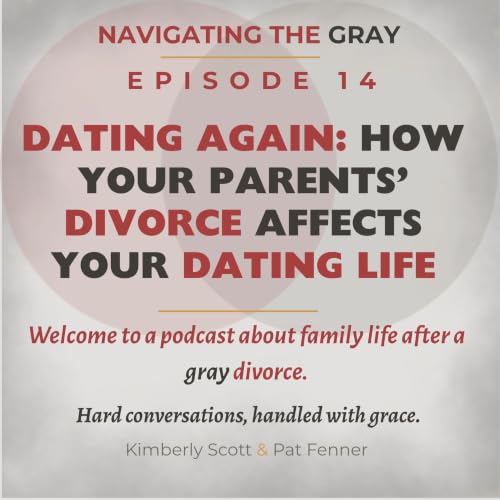
  • 14 - Dating Again: How Your Parents' Divorce Affected Your Relationships
    Aug 19 2026

    Long after the divorce papers are signed, many adult children continue discovering ways their parents' divorce shaped their own relationships.

    In this episode, Pat and Kimberly discuss how gray divorce can influence dating, trust, commitment, communication, and expectations for marriage—even decades later.

    Rather than focusing on blame, they explore how recognizing these influences allows us to become more intentional, healthier partners and build relationships that aren't limited by the past.

    In This Episode
    • The relationship lessons we absorb without realizing it
    • Why some people fear commitment while others fear being alone
    • How gray divorce changes our understanding of marriage
    • Learning to become intentional instead of cynical
    • Why communication matters more than ever
    • Questions worth asking before making lifelong commitments

    Your parents' divorce may have influenced your view of relationships—but it doesn't have to determine your future.

    Healing is possible. Healthy love is possible. And every relationship gives us another opportunity to write a better story.

    "What you have seen does not have to become your experience." ~ Kimberly Scott

    Use these questions for deeper thought or journaling:
    • What relationship lesson did you learn from watching your parents?
    • Has your parents' divorce affected your willingness to trust?
    • Do you find yourself avoiding commitment—or rushing toward it?
    • What assumptions about love might need a second look?
    • How can you create a relationship story that's different from the one you inherited?

    We'd love to hear your thoughts. Use the SpeakPipe link to share your experience. Your story may encourage someone else walking a similar path.

    Free Resources

    Whether you're navigating gray divorce yourself or you're an adult child of divorce, help yourself to the free guides we’ve created to help you move forward with greater clarity and confidence.

    📘 For Divorced Parents: Post-Gray Divorce Recovery Guide

    📗 For Adult Children of Divorce: Healing & Relationship Guide

    Show More Show Less
    38 mins
  • 13 - 3 Myths to Navigate About Forgiveness
    Aug 5 2026

    What if forgiveness doesn't mean what we've always thought it means?

    After a gray divorce, forgiveness can get complicated—for the former spouses and for their adult children. There may be old hurts, unanswered questions, broken trust, resentment, guilt, or an apology that never came.

    And then we're told we need to forgive and move on.

    But what does that actually mean?

    In this episode of Navigating the Gray, Pat and Kimberly unpack three common myths about forgiveness:

    • Myth #1: Forgiveness means saying what happened was okay.
    • Myth #2: I can't forgive until the other person apologizes.
    • Myth #3: Forgiveness means reconciliation.

    We talk about the important differences between forgiveness, reconciliation, and trust—and why forgiving someone doesn't necessarily mean giving them the same access to your life they once had.

    We also explore forgiveness from both sides of a gray divorce: the parent who may be carrying hurt, resentment, regret, or guilt, and the adult child who may still be processing the choices their parents made years ago.

    Sometimes forgiveness leads to reconciliation.

    Sometimes it leads to new boundaries.

    And sometimes it simply allows us to stop carrying something that has been taking up far too much space in our lives.

    “Forgiveness doesn't always rebuild a relationship. Sometimes it rebuilds

    the person who was hurt.”

    A Question to Carry With You

    Is there someone you're waiting on before you allow yourself to heal?

    Maybe forgiveness isn't about pretending the hurt didn't matter.

    Maybe it's about deciding the hurt doesn't get to write the rest of your story.

    Free Resources

    If you're navigating gray divorce as either a divorced parent or an adult child of divorce, we've created free guides specifically for you.

    📘 For Divorced Parents: Post-Gray Divorce Recovery Guide

    📗 For Adult Children of Divorce: Healing & Relationship Guide

    Important Phone Numbers

    • National Domestic Violence Hotline - 1-800-799-7233 or text START to 88788
    • National Child Abuse Hotline (Childrelp) - call or text 24/7 1-800-422-4453

    And if this episode resonated with you, follow Navigating the Gray and share it with someone who might need this conversation today.

    Show More Show Less
    35 mins