This post was originally published on Audible.com.
Note: Text has been lightly edited for clarity and does not match audio exactly.
Katie O'Connor: Hi, listeners. I'm Audible Editor Katie O'Connor, and today I'm honored to be speaking with National Book Award-winning author and poet Elizabeth Acevedo. Welcome, Elizabeth.
Elizabeth Acevedo: Hi. Nice to be here with you, Katie.
So excited to have you, and congratulations on your new novel, Anger Is Only a Shadow. The book, written in poetry and prose, is about Lil, a teenager recently out of juvenile detention who is now on probation and struggling to toe the line, especially as her big brother Aldwin, who's away at college, starts to behave more and more erratically. This is your first YA novel in six years. What did it mean to you to come back to the genre?
Oof. It's funny because I began writing this book while in the process of launching my last novel, in 2023, which was my first adult novel. So, I've been living with this young adult novel in my life and in my brain for a long time. For me, I didn't feel that distance in quite the same way that I think some of my readers did. But once we announced the cover, and just the sheer response of folks who were so excited to have something written for a younger audience, it really blew me away. I don't know, when you're in the work, you just don't feel time, I think, in the same way.
I'm someone who will stalk an author I love every couple of months, like, "Is it out yet? Where are we at with it?" So, I understand that feeling of wanting your writer to put something out. It was a funny parallel to be like, "Oh, this is what those folks are doing. They are in the world that they're writing, and they don't feel time quite the same."
Yeah, when I heard people say it had been six years, and maybe it was because of your adult novel as well, but I almost didn't feel that gap because I think for me, you're one of the rare authors that I actually go back and relisten to. I think it has so much to do with your poetry, too. I just want to kind of get myself back in the words that you've given us, and so I was a little taken aback about the six years thing. It's interesting that you say you don't feel that time.
As I mentioned, this novel is written in poetry and prose. You have beautiful poems that close out chapters. Can you talk to me about the balance of each and the writing process? Did the poems come separately and you inserted them later? Did they come first? How did that all work for you?
Initially, I thought that the whole novel was going to be written in prose poetry. So, on the page, they were these blocks of text, but they had a kind of rhythm and musicality that made me think this isn't just straight-up prose. I'm leaning into the fact that this writing sometimes veers away from just telling the story straight-up and is actually concerned with language, that that is a primary concern of this novel. So, it has poetry in it. And then I couldn't hold all of it. It just became a little complicated to like, “Well, what are these pieces that are the ‘Where I'm From’ poems, and what are they doing and how do they fit in with these prose poetry blocks?” I had to kind of say, "Okay, the prose blocks are prose, and that's her where she's feeling, and that's where the narrative is taking shape."
I think where you begin a story is one of the most critical things, maybe even more important than where you end a story.
Then we have these poems where she kind of situates us either in where she physically is or where she emotionally is. Those are the “Where I'm from,” “Where I'm At,” “Where I'm Going.” This kind of meditation that she's doing on a very early prompt that she got at juvenile detention, of the famous “Where Are You From?” poem that she kind of returns to time and again.
So, I had to figure out the shape of it, but I never really know what I'm making until it's either halfway or fully made, and then I can see, "Oh, okay, here's where it has to be reshaped." So, the project that I thought I was writing, [is] slightly different than what I ended up with. Although, I think people are talking about it—and maybe it's mostly folks who are listening—as if the whole novel is in verse, or as if the whole novel is in poetry. That's such a high compliment to me, because it's like the language fits regardless of what my project was. The listeners are receiving it in a very different way.
I think it has so much to do with your performance, too. You're just incredibly lyrical in the way that you are delivering the prose as well. So, I do understand how maybe some listeners might think, “Wait a second...” So, the inciting incident of the novel—Lil taking the keys to her mother's food truck and crashing it—happens before the book begins. Her two friends that were with her and a huge part of her life before the crash don't really appear, at least materially, in the rest of the story. Was this always the structure of the book, or was there a version where you chronologically took us through that event?
No, the novel always began with her explaining the rules of juvenile detention, and it always started with the fart jokes.
Which were great (laughs).
(laughs) I think so, too.
Like, who doesn't love a little lactose intolerance in their novel? I mean, come on.
This is one of those things where I'm like, I love chatting about our intestines. But for me, that was where the story began. I think where you begin a story is one of the most critical things, maybe even more important than where you end a story, sometimes. Because it is the launchpad, and I think there's a needing to perfect the instinct of “How much does a reader need to know?” For me, I wanna drop you in the world. It's why so often my stories begin with, if there's a death, it begins with the death. We're not going to get too much beforehand.
I think that's counterintuitive. A lot of people like to build the world and have the reader fall in love with the world, and then they shift it on them. For me, it was a little bit of, yes, this is the world as she knows it, and this is her new beginning, and she has to kind of surrender to this moment. I need the readers to be in this constraint space so that when she gets out, that feeling of borrowed freedom is impactful. If they see the freedom beforehand, then this was just a stop. I don't want it to feel that way. I want it to feel like this was the stop. Like, literally stopped in her tracks and now is the deciding point of “Who are you going to be?” Because the way things are set up, this might be your future if you don't make a different choice.
What's your process for giving presence to characters who never really appear? I mentioned that her two friends that were with her in the crash then don't have a strong tangible presence in the novel. We see them in her memories and sort of brief interactions. You also do this to incredible effect in Clap When You Land, as well, with the father. I'm just curious what that process is like for you to giving these people who aren't necessarily there physically such a strong presence in the book.
I guess I just write a lot of haunt scenes. It's a little bit of “How do I make sure that this person is at the forefront of the main character's mind?” They're always contending with "What would they say if they were here? Who would I be if they were here? What choices would I make?" It's Lil looking at the lunch table she shared with her friends and seeing a new group of juniors sitting there and being like, "That was our table. And I can't even go fight for her because I don't have the people who would stand by me." It's her walking by the locker and looking at the lock like, "They're gonna clip that, because she's not here anymore.”
Oral history and oral storytelling and how we've passed down what's important, not only to an individual but to a people, there's something there I want to honor and something there I want to make space for.
But for me, it was the moments of “What does the character observe in order to make sure that we know that she is preoccupied?” Literally occupied by the memory of these people, and that they were important to her. She very early on said she's not abandoning her friends. She contends with what does it mean to make new friends? It feels like she's betraying, and so it felt important to me to make sure that they were mentioned and dropped in and referred to as often as possible.
I saw on your Instagram that Anger Is Only a Shadow was the 51st title of this novel. Is that typical for you? I bring that up now because it is from a line in the book, and it is actually a line from when Lil is interacting with her friend Britney's mother. So, how did you finally emotionally land on that being the right one?
My titles are always so interesting because sometimes I just know, and that's what it is. And sometimes I think I know what it is, and then my editor and my agent and the team is like, "That's not a great title" (laughs).
"You are wrong" (laughs).
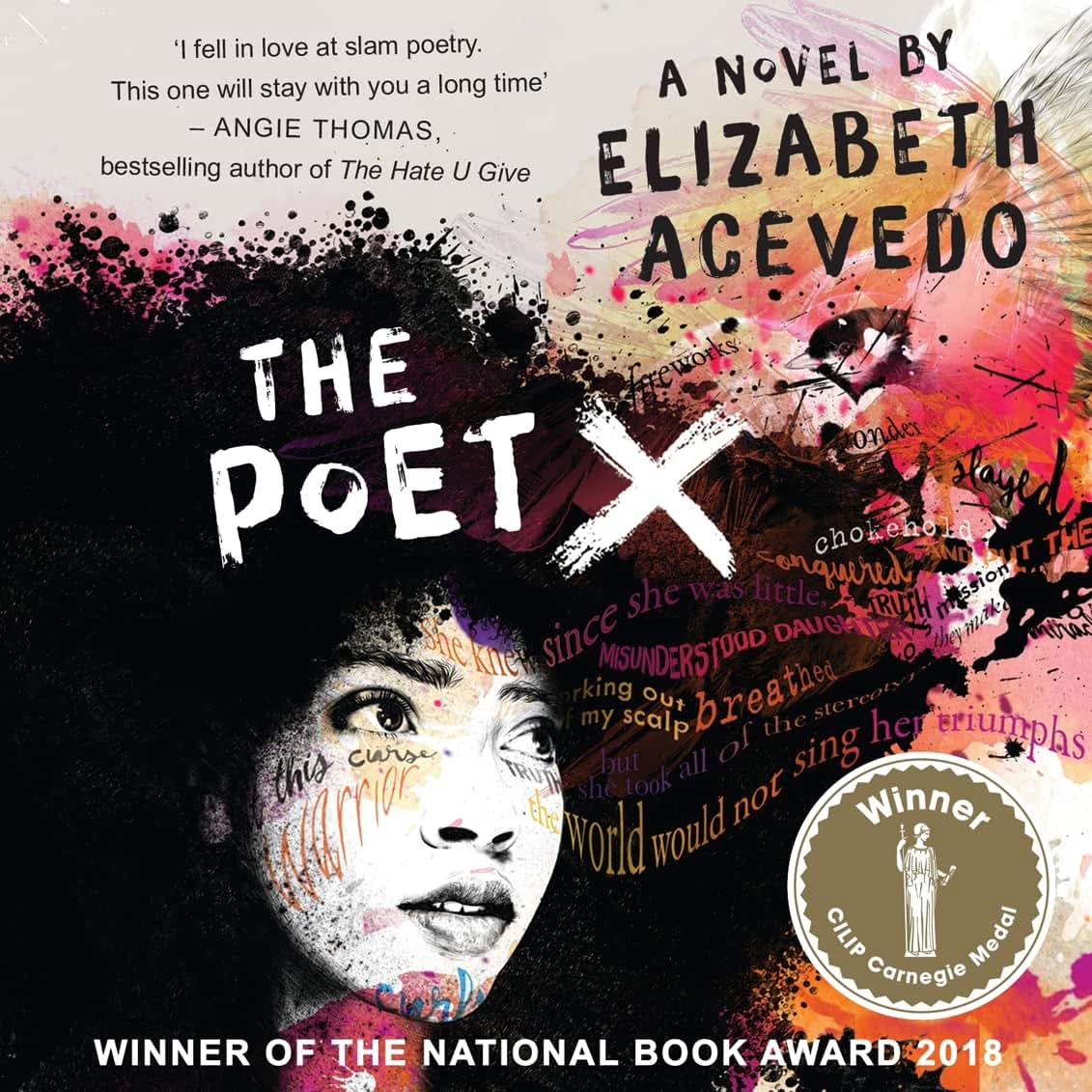
"Incorrect." With The Poet X, I thought that was the placeholder. I was like, "Yeah, no one's gonna—this is just folks coming up in spoken word are often the Poet Whatever. And so we'll just hold that." And then they were like, "No, we love it." I'm like, "Uh, okay." Clap When You Land, I knew from the beginning. I think it holds all of what it should hold. I would say every other book had a very similar route as this one, Family Lore and With the Fire on High, where it was my sending lists as I would read through the whole book, pull out what I thought were poetic or interesting, or smashes of language that felt vibrant, like you could hold them. And then all the folks who worry about how books get sold are like, "Eh, that's not it. That's not it. That's not it." Then I remember writing this line and being like, "This is it.” Anger Is Only a Shadow is like a jewel in your mouth. You wanna hold that.
That's so beautiful. You should put that in the back pocket. Idea for another book title. You talk a lot about mythology in Anger Is Only a Shadow. Lil's grandmother always told her myths, and then in this really poignant and difficult moment in the book, Lil uses a myth to help bring her brother, Aldwin, back to reality. You also have a chapbook called Beastgirl & Other Origin Myths. Have you always loved mythology? And do you have a favorite myth?
Katie, you can tell, like, “She's obsessed with myths.” You know more than most that we grew up with Xena: Warrior Princess. We had all of the Greek mythology on our TV. We had Hercules. In school, there was such a vibrancy to the Greek mythology unit. I've always been drawn to the stories that people tell in order to make meaning. Then, not being from a Grecian Island, being from a Caribbean one, but not being told a lot of the myths that my people come from, the moment that I was like, "Oh, not only did we have magic, we still have magic." There's something powerful here in what it means to recover those stories and almost sneak them back to us in the capsule of a more mainstream novel, but say, "This is ours."
I am a poet. I was a spoken word artist, and I performed a lot. For me, there's something powerful about being on a stage and reciting a poem and watching people respond to you. Oral history and oral storytelling and how we've passed down what's important, not only to an individual but to a people, there's something there I want to honor and something there I want to make space for.
I feel like this is a segue then to the question of you being the narrator of Anger Is Only a Shadow, as you have been on all of your audiobooks. You are such an incredible performer, which makes sense, frankly, given the fact that you are a poet, because poetry has such a strong oral history. I think poetry and orality are intrinsic in a way. Do you still enjoy performing? And what's one thing that you learned about this story through the process of recording the audiobook?
I enjoy performing when it's not required of me. I no longer take events where they're like, “Come do a set.” Because there's a pressure there of “Be the performer.” But if I'm invited to keynote a library event, and then I just bust out a poem and people are like, "Oh, shit. She's still got it." That, I like. Because it's like, “You didn't even know I'm still in game shape” (laughs). So, I will periodically, just to remind myself and remind people who I am, do a poem. But there's a joy in that.
It's editing with my ear. It's not with my eye. It's a listening edit. By the time I get inside of the recording studio, I have probably listened to myself say this work for over one or two years in many iterations.
I love doing narration. I think I live with the language out loud the entire time I'm writing. I recite while I'm writing, and I go back, especially if I'm loving how something is going, I'm starting back at the top and rereading the whole page and starting back at the top and really aiming for precision. It's editing with my ear. It's not with my eye. It's a listening edit. By the time I get inside of the recording studio, I have probably listened to myself say this work for over one or two years in many iterations.
The narration, to me, for Anger Is Only a Shadow was wonderful because when I go to do the audiobook, it's when I know whether or not I landed the novel. Because it's my last time. It's usually three to four months before the book is out. The book often is either going to print or already at print. So, any last changes that I have, I find in that last recording, and it's like, “Call my editor right now. I found a typo, or I found this.” It's like the last absolute moment.
Stop the presses.
Exactly. It's how I know, “Okay, it can go to print because I just sat with it for three days, eight hours straight, and it was where I needed it to be.” I think Anger just gave me such a confidence of, yes, this was the story I was trying to tell. There were moments where I was smiling in the studio. I wonder if you can hear the smile, or where I was making myself kind of cackle, or where I felt myself emotional. As a performer, I tried to always have enough distance from the writing that I'm not overcome by it. That if I'm emoting, it's because that's what's required by the text. It's not catharsis in that moment. But there was a segment in Anger Is Only a Shadow, I was like, "Oh, I need a moment." I was pulled in, in a way I hadn't imagined I would be. Where it was more than just being the narrator. It was maybe even more than being the writer. It was like, “Oh, as someone who is in this book, I am moved." I would say there's been maybe two times in my writing history where it's my own work and I'm like, "Ooh, I need a moment.”
I mean, just personally, as someone who had a brother who had a lot of struggles, I think there were several moments, too, where it almost became, as a listener, difficult in that sense. I think your language, though, helps so much with the processing of that. It gives words or gives metaphors to kind of what you're feeling that just help watering through those emotions.
Oh, I'm happy to hear that. I didn't know what I wanted from this book, and I think when you're in it with a family member, and you're in it for years, and you're trying to figure out something that there's no rule book for, and often very little that you can do. I think it's going to be the greatest wound of my life, probably, for my life, just an inability to figure out how to meet my brother where he is now and not where I imagined he would be. I think in this book, it was a release of that as the only kind of story, and a “Well, what would those early days have been like, or could they have been like, with more resources or with a different approach?” Let's just look at the early days. The other stuff is a little too complicated, but maybe it gives language to folks who are going through this, and maybe it doesn't give language. Maybe it just makes us feel slightly less lonely.
I appreciated how relentless Lil was in pursuing help, in knowing that help was what was needed, and not time and not distance, and not letting him figure out his own journey. It needed to be action and nothing else, and not letting go of that, even if it meant something terrible for her own future. There was such bravery in that. It just made me love her so much as a character.
Me too.
So, thank you. She's a good one. But when the novel opens, Lil is in a youth services center, and you yourself worked in a youth services center, is that right? How did your experiences there shape this novel?
I did. I worked at a youth services center here in Washington, DC, for two, almost three years. I was a teaching artist, and I would go in twice a week. For the first year, I toggled between the young men's unit and the young women, and then I primarily moved into the young women's unit. It's an adjudicated youth center, so it was very transient. There would be young people that I saw for two or three weeks, and then they would go be released or would move to a different system. I would keep showing up. There'd be new groups of people. We did the “Where I'm From” poem many, many times. And then some people would come back, and it was like, "Oh, it's so good to see you." And also, like, "Oh, I wish it wasn't here."
There were moments where I was smiling in the studio. I wonder if you can hear the smile, or where I was making myself kind of cackle, or where I felt myself emotional.
So, I think initially there was that “How do you create familiarity and relationship and bonds when folks are moving?” And writing requires so much trust, and sharing your writing as a young person in front of other young people who may start roasting you, it's hard to build that culture. And yet so often they held it so well. I think that's what I walked away with. Like, this is a space where the goal isn't for love to be modeled, but something's happening here. There's a stripped-down version of all of us in this space that keeps disrupting the performance these young people are trying to give of being tough and immovable and unshakeable. And then the things they would write and decide to share, they would let each other in, they would let me in, and I think they would language things they may have never really thought about. It was so, so brave and so honest.
I didn't think I was gonna write about it. I've done so many different kinds of teaching gigs, and it was just being present and holding that space for them, and trying not to be overwhelmed, because it can be. Every time I went in and I would hear all those doors clink behind me, and just the anxiety I would feel and then be like, "They live in this every day." There was a lot that I was taking away, but I didn't think of it as, "Oh, this is imagery, this is sensory, this is something ..." I didn't journal about any of it. It was just what I was doing at the time. The story of Lil and her brother came as a separate idea. I thought they were going to be two different books and then ended up seeing that maybe there was a way they could coexist. But something about that setting really called to me.
It's interesting that you say sensory. There is so much sensory detail there in that setting, not to mention the fart jokes, another sensory detail that happens in the opening of the book. But the guards, all of it. As you alluded to, while in the youth services center, Lil is introduced to bell hooks. And then later at school, she is introduced to Toni Morrison. I know that you wrote this book, obviously, a few years ago at this point, but both women are very much having a resurgence in 2026. What is it about them that you think not only endures but is so important for the current times that we're in?
Oof. Do you know what's interesting? When I began writing this book, it was only bell hooks. All About Love was the text that was kind of carrying Lil through and that she was referring to. Because I was so moved during the pandemic by All About Love, and it changed how I navigated. For me, it felt like a gift to introduce readers who, through my work, maybe found a doorway into bell hooks. This is before Communion really was being announced that it was being published, and I think Communion has brought hooks into a conversation in this moment that we desperately need.
But I went on my own journey to read all of Toni Morrison's work, and mainly listen to it because she narrates. There were initial narrators, and then she went back, I think, in the last two decades of her life and redid the majority of her backlist. Listening to her voice has been so meditative. I'm working on this novel and I'm listening to Toni Morrison. I'm like, "Wait, she's someone that I think would really have an impact." And then the book clubs and all the return to Toni Morrison, return to bell hooks, and it felt almost prophetic, or maybe like a lot of us are tapped into the same kind of stream of thought of “These are our ancestors. These are our literary ancestors. These are our literary elders.” We're in a moment right now where the country of the United States and the world can feel like we are on the brink of dystopia some days. And these are two writers who were so clear-eyed, not only in naming the dystopia but in how do you make it through.
When you read Sula and Toni Morrison talks about evil, and the objective of evil, she is very clear what she names as evil, and she's very clear at the objective is only to survive it. It's not to enjoy it. It's not to indulge it. It's just to survive it. And that is enough. I think, similarly, when bell hooks talks over and over about community and how we love the spiritual growth of the other, and that that is love, I think there's something there. Healing is an act of communion. Something about that line, I realize, I think I've been writing towards that for such a long time. We come together, and that is how we witness each other's wounds, and then those wounds heal. So, for me, I think their resurgence has to do with what this time calls for, and the language they left behind for us to turn to is a balm.
I think it's going to be the greatest wound of my life, probably, for my life, just an inability to figure out how to meet my brother where he is now and not where I imagined he would be.
Yeah, this book is so much about isolation and loneliness and what happens when you keep things to yourselves as opposed to sharing your pain and sharing your burden with the people around you. So it is such a natural fit in that sense, too. If Lil were to recommend a book today, what do you think it would be?
I love that I was able to sneak in Roque Dalton, who's an incredible Salvadorian freedom fighter and thinker. I think she's very proud of her heritage. I don't know that enough folks know Roque Dalton, and so maybe she would talk about him. There's so many good books.
What's one book that you yourself would recommend specifically to teens?
I really love the book Shook by Julian Randall. It just came out. It's probably more middle grade than young adult. Also deals with mental health. It's written in verse. The language is beautiful. It's set in Chicago. This young middle school basketball player wants to be the guy, and his dad was the guy, and then he gets injured. So, much of the book is not about him being the guy. It's about him healing, and there's something about that book that feels really special. I think a lot of readers would just love the language and love how fresh it feels and how real it feels, and this kid's world, who is so special. So, I would say Shook is really an incredible book.
I'm going to have to put that on my list right now...
And Julian was a spoken word artist, so I think he did his audiobook. Enjoy, Katie. You're welcome (laughs).
Thank you so much. This was really for me, guys (laughs). You are about to embark on a big tour. What are you most excited about in these next couple of months, having Anger Is Only a Shadow out in the world and just getting to connect with your readers and listeners?
I'm always so surprised. I show up to places and I'm like, "Is anyone gonna be there?" And then there's all these readers there. It feels like I'm in my own little silo, working on this text and imagining readers. It's so different than getting up in front of a stage and performing. The immediacy of: I wrote a poem, I memorize it, and maybe three weeks later, I'm on a stage, and I feel the response to that poem in real time. I don't know what the book is in the world doing and who is grabbing it, who's at these conventions, who has NetGalley and has early editions, et cetera, et cetera. And then I go to events and I'm like, "Wait, you already read it? It just came out today." And then "Yes, I spent the whole afternoon for this event."
I'm thrilled. I think I'm in a really good place in terms of myself as a writer and a person that I can actually receive the energy of this, where we come together. You probably read by yourself, I write by myself, and now we're having this exchange where your mind and my mind can discuss the thing that happened between us.
A communion, if you will.
Katie, stop, you need to write all my copy. There we go. But it's that. It does feel a little bit like, “Ah, this is the payoff.” It's being able to celebrate with folks who are also geeked out about the things that I'm geeked out about that I cobble together between all the different things I find interesting or curious, or my particular style of writing, which is very heavy on language and not always on plot. And then there are people who are like, "Yes, I too just am here for the vibes and the poetics." And something's happened. It's like, “Ah, you see me, and you feel seen by me, and this moment is powerful.”
So, I think all the stops were super intentional. I'm so excited to be able to see a lot of the Midwest, which will be really fun. I feel like folks have been reaching out for a long time, and I get to do a really cool sweep through there. It'll be great. My bestie's acting as my tour manager, so I get to be at these places with someone who's known me since I was five and is bringing a little bit of home with me. I have a lot of preparation for all the things I'm going to eat in all of these very amazing places.
A woman after my own heart. Yeah, you gotta plan all those food stops.
I'm just here for the meals (laughs).
That's incredible. Well, enjoy it. Enjoy the interaction. Enjoy just the joy of having this book out in the world, and congratulations.
Thank you. I appreciate it.
And listeners, you can get Anger Is Only a Shadow by Elizabeth Acevedo right now on Audible.