This post was originally published on Audible.com.
Note: Text has been lightly edited for clarity and does not match audio exactly.
Dawn Gentle: Hi, listeners. I'm Audible Editor Dawn Gentle, and today I'm excited to be speaking with bestselling author Louise Penny. Her beloved Chief Inspector Armand Gamache series, set in her home province of Quebec, Canada, has become one of the most celebrated mystery series of our time. Now, 21 books into the series, Penny returns with Miss Wolcott's Ghost, a haunting new mystery that sends Gamache into the mythical Lost Nation deep in the Quebec forest. Welcome, Louise.
Louise Penny: Oh, thank you, Dawn. And hi to all the listeners.
Let's just get straight to it because this story, oh my gosh, it was amazing. I enjoyed every bit of it. I took my entire vacation listening to this, by the way, my whole birthday weekend I took listening to this book. I was nailed to it. Everybody kept saying, "What are you listening to? What are you doing all day?" I was glued to it. That's just how good it is. And we love Inspector Armand Gamache. The story begins with him, he receives this shocking wake-up call from a mysterious voice saying, "There's a body in Lost Nation." How did that first scene come to you, with the caller's identity being part of the mystery?
It's always good to start with a mystery (laughs). To pull people in. I know I like that. Some people prefer to start with the actual body. I try to mix things up. As you said, this is book 21, so you don't want to be formulaic. So, you start each book in slightly different tones, different ways.
Lost Nation came about because I had heard about this Lost Nation, which it's sort of mythical, but it actually exists. Or it's more mystical than mythical, perhaps. I'd been toying with the idea of using Lost Nation for a while. The story itself sort of coalesced around this idea of a community that's been lost to time. So, the phone call comes in and wakes Gamache up, which as we've all had those late-night calls, and they're terrifying. Many of them are spam calls, which is really annoying. This one clearly was not. And what was fun to play with as well is that while Gamache and his wife are shocked out of a sleep, she actually answers the phone and she's trying to make heads or tails. She's trying to hear. The voice is muffled. It's unclear what he's saying. And then she hands the phone over to Armand, who can hear it, but it still doesn't make sense. “There's a body in Lost Nation.” And he asks the guy to be more specific. But in the back of his mind, he kind of recognizes the voice or thinks he might. But again, he's coming up from a sleep, and so there's just all sorts of things that he's trying to grasp hold of.
Yeah, it made me feel intrigued to delve in more of the mystery, just from that very beginning. And like you mentioned, Lost Nation feels like it exists between legend and reality in those Quebec forests. I definitely get that, and I pondered, "Is this inspired by a real location?"
Well, do you know what, one thing that it's probably worth mentioning is, initially, when I first thought about this book, the title was The Lost Nation. It's actually a pretty good title, except, unfortunately with sort of the political situation and my last two books were fairly political, we thought Lost Nation actually has nothing whatsoever to do with politics, but it can give that impression. So, as the book went on, it became clear that really a better title and more appropriate title is Miss Wolcott's Ghost.
I definitely get that Lost Nation would feel like it can be a little close to home, although it's not. But you do touch base on real-life events that happen in Canada. I found that so intriguing. The investigation, it leads to a forgotten maritime disaster that rivals the Titanic. I did my research. Because Gamache goes into great detail, and Louise, thank you so much, because I love the fact that you explain what happened during that time in such great detail that it felt like I was there. I felt those real moments when they were researching it and wondering, “How did they not know about it?” I felt the same way. I said to myself, "How did I never hear about this?" I Googled it, and that's when I was able to find out about it.
There's so much in Canadian history that is fascinating. When I was growing up—and I'm 68 now, so we're looking back at 50, 55 years now in taking history—the history that I was taught was British history or American history. Very little Canadian history, which was such a shame because, of course, there's history. There's human struggle. There's drama, there's sacrifice. We have immigrants that came to the Canadian West and set up homesteads with great, great adversity. Terrible things were done to the Indigenous population that we have glossed over and that we're only now beginning to come to terms with. There are a lot of atrocities that the Europeans visited on not just the Indigenous population, but frankly, on each other, that needs to be looked at, explored, explained, come to terms with.
One of the things that somehow got lost in all of this was this maritime disaster. I went around to cocktail parties—I'm sure I became just so annoying—asking them, "Have you ever heard of this? Have you ever heard of that? Have you ever heard of Lost Nation? Have you ever heard of this maritime…?" And it's like, "What is this? Jeopardy? Why are you asking us these questions?" And Miss Wolcott is also inspired by a real person, so I asked about that as well. Of course, as a writer, Dawn, the answer I want is, "No. We've never heard of this." Which is, as a writer, a perfect answer because I love that there's a mystery surrounding so much of this and that people want to explore it.
As a human being, as a Canadian, it is shameful that we don't know about lots of these things. But I'm in the happy position with Miss Wolcott's Ghost that I do get to explore it. The fun thing—it's fun, but it's also a bit of a challenge—is to do it without making it feel like a history lesson, or like, “People, this is something you should know, so I'm going to tell you all about it.” But make it seamless and compelling, I hope.
Definitely, it was. I was so engaged. And like you mentioned for Lost Nation, this is also a place where even Gamache himself has never heard of or been. When he gets there, he finds this victim. And with this victim, you cannot figure out who it is, what it is, how long it's been there. They've been trying to get that all figured out through forensics. So, without giving too much away, what made you want to blur the line between past and present so dramatically in this murder? Because it is dated back to that time where that ship had that tragic accident.
I wanted to explore what happened to the ship and to the people. I wanted to figure out a way to bring it forward so that it was pertinent. You described the body found in Lost Nation, and we hear about that. We're not giving anything away, as you said. It's essentially the first line of the book. “There's a body in Lost Nation.” And once Armand discovers that Lost Nation existed and where it is, he finds the body on a grave next to a tombstone that has a date but no name. And so that propels them forward into figuring out who's buried there, why the date, why not the name? And certainly who this person is who has this very strange plant growing around him and through him, and where did this plant come from, because it's not one that anyone has ever seen before.
In terms of Armand, we're just getting to know him deeper and deeper and deeper, and seeing him in different situations and seeing his humour, his resilience ... I hope, more than anything, he comes across as just human. A good, good person.
I love that part, too, because if you don't know your plants, listeners, I promise you, listening to this book, you will learn about some of them. I loved that aspect because I, too, love flowers. I'm a plant person. So, hearing about those—and I won't explain because I don't want to provide any spoilers or take away from the central plot of the story. But it's one of those plants where it can save or take countless lives, that's how it's described. How did you research the botanical elements of this story? And what is it about the intersection of science and danger that fascinated you?
Oh, that's such a great question, because I think we're facing that now with AI, with so many things. I remember when I was doing interviews, I was hosting an afternoon show for the Canadian Broadcasting Corporation and I did hundreds, hundreds, maybe thousands of interviews. And you remember a few. One that actually sort of informs some of what's happening in this book, but also, in many of the books is this intersection of science and safety. The interview that I remember, and I must have been in my early 20s, it was with an inventor, and I can't remember for the life of me now what he invented. I think he was a professor. He was quite elderly at the time of this interview. And the thing that he said is that "You must know that we almost never understand a thing that we invent. We think we do, but then it has all sorts of applications that we did not dream of. Many of them wonderful, some of them appalling."
That stayed with me, the idea that we don't really know what it is that we have created. It can be a monster, or it can be a great gift to humanity. And the same with this plant. Is it a monster? Is it something wonderful? I go fairly often to London for a number of reasons. One trip, and this must have been, oh, 10, 15 years ago, I went to—because I love plants as well. I love horticulture and I love science. One of my favourite gardens in London is the Chelsea Physic Garden, which is filled with all sorts of medicinal plants. But I was at another plant museum, just off the Thames, and there was a description of this eccentric Victorian woman, never married. She was one of these remarkable Victorians who just went off on her own into the middle of nowhere and collected all sorts of plants. I wrote down this story and just filed it away and thought, "One day I'm going to write about her."
So, I started writing about her and used her real name in the book. Then I realized that, actually, I have to fictionalize my character so much that I could no longer use her real name, so I changed the name. But in the acknowledgements at the back, I do describe who she actually was. But it's so much fun. It's so much fun. I feel like a vacuum cleaner. I just vacuum up ideas. A lot of it is crap, and some of it is gold. Or a bit maybe like Frankenstein, too. It's just sort of cobbling together these ideas and thoughts and quotes and—
It's more like beautiful madness.
Oh, there you go. Okay. Yeah, that's much better than maybe the vacuum cleaner. (laughs)
It’s good because it led to such a great story.
Ah, thank you.
This will probably be one that I will never forget, of the series. The title Miss Wolcott's Ghost evokes a haunting presence—presumably, the eccentric Victorian botanist whose lost documents are central to the plot. Who was Miss Wolcott to you as you wrote her, and why does her ghost story matter to this story?
Ah, another great question. I grew to really care very much about Miss Wolcott. When we first meet her, she's a child. Her name is Daisy, and she hated the name because she felt that it was very below-stairs, even though she felt like she belonged above stairs. She was an only child of a very wealthy industrialist who everybody looked down on because he flaunted his money at a time when the landed gentry really liked walking around with things with holes in them. So, she really struggled with who she was and confidence. The neighbours didn't like her because she was eccentric. She was an eccentric child. She grew into an extremely eccentric older woman who just did her own thing.
I talked to some friends who were reading the manuscript, and they said initially that they didn't like her at all, because frankly, she was unlikable at first. But then as she gets older, as you get to know her better and better, you realize what a remarkable person she was, and, in fact, quite unique in her way. I think we all feel misunderstood at times. I liked writing about her vulnerability, but at the same time, her courage, her desire to be included. But, also, her desire to push back and do things that would make her excluded. All the things that we can sometimes do when we are unsure of ourselves.
Yeah, I actually liked her character. I related in a sense, where I always naturally have empathy for those who get overlooked, mistreated, and she did go through those things. It made you understand why she was the way that she was. We also learn, deeper into the story as well, about Clara Morrow and the Morrow family. They appear to have a deep, possibly unsettling connection to Lost Nation. We know Clara. We learned about Clara 20 books ago, and she's loved. She's throughout all these books, but this time around, she's more central and placed in a complicated role in the investigation. Can you expand on that?
Well, one of the things when they try to trace that call is it seems to have come from Clara's phone, and Clara says she has no idea why that was. So, they're trying to find out, is she telling the truth? And then all sorts of things start popping up about the Morrow family, her husband, Peter Morrow, who's no longer in the picture. So, that was fun, too.
When I started writing the book, I didn't really know where that was going to go. It was a lot of fun to explore the history of the Morrow family, who are vile. They are not nice people. Peter was the outlier, but still very troubled. He married Clara and then things sort of fell apart, these two artists. Peter, particularly, with an ego. But we get to revisit that relationship and the family and the history of that family. It's wonderful to be able to blur, as you've said so eloquently, the past and the present in these books, in this book in particular. And to bring back, now that I have this archive of 21 books and characters and events, to be able to reach back and bring some of those forward, it's thrilling. The challenge is, for people who haven't read the previous 20, is to bring them up to speed so that it's also, I hope, seamless and interesting rather than just a data dump.
I loved it because it's fresh, and fresh in a sense where you mixed it up a lot in this. We get these beloved characters, we get some that come back, and I'll leave it at that. So, for me, it just felt like intertwining, even with the books itself, some of the past with the current. And one of the main current places is Three Pines. It’s a state of mind as much as it is a place. And 21 books in, how do you continue to find new emotional territory for Armand Gamache? What does Three Pines mean to you now, over a decade after publishing the first novel, Still Life?
I would be interested in going back at some stage and rereading Still Life and see what I said. I know I actually made a few boo-boos along the way. I have not tired of Three Pines or of Armand. I think because Three Pines is, as you said, a state of mind. It's a physical place in the books, but for ourselves, it's when we choose to be decent and kind and compassionate rather than cruel, when we think of the cutting remark, but we set it aside and say something supportive—something I don't always do, but I aspire to that. These days, because the books were, in many ways, inspired by 9/11, we always need a safe place, a safe place in our hearts, a safe place to go to if and when we're afraid. And Three Pines provides that. That, in fact, is the symbolism of the three pines, which were initially, centuries ago, planted as a symbol, as a code. When people come across a town or a home with three pines planted in it, that means that they are safe. And that's actually a true story. So, we all need a safe place, and never more so than now.
I have never grown tired of Three Pines and the comfort that it provides. In terms of Armand, we're just getting to know him deeper and deeper and deeper and seeing him in different situations and seeing his humour, his resilience, the fact that he isn't perfect. He has his struggles as well. I hope, more than anything, he comes across as just human. A good, good person. And there are more good people out there than there are cruel people. I know that. I know that they're in my life. I'm speaking to one now, clearly. It's nice to be able to reflect that. It seems to be a truism, which is not true at all in fiction, that good people, decent people, are boring or difficult to write. I think it's much more challenging, too. Anyone can write about someone who's cruel. That's not hard. It's writing about someone, and it's so much more challenging, to be a decent person. That takes courage.
We always need a safe place, a safe place in our hearts, a safe place to go to if and when we're afraid. And Three Pines provides that.
That is so true. And that's the perfect way to explain Gamache. We got lucky with this book because we get Alfred Molina, who if, listeners, you don't know, he played in the TV adaptation as Gamache. He portrayed him, he embodied him. I loved the TV adaptation. He's so good. I love the fact that you got him this time to narrate this book, because that's all I think of in my head now. After seeing the adaptation, in my mind, I'm picturing him. I'm picturing it like a movie in my head as I'm listening and I only see him. He also describes the experience as “a privilege.” So, what was it like knowing that the actor who has become Gamache for so many people would be the voice bringing this particular story to life?
Well, I was overjoyed. Fred and I have become friends over the years. In fact, I was just today emailing with him about the audio because he had so much fun doing it and he loved working with the team. He loved being back, thankfully, with the characters. What's fascinating, of course, with the audio, which is self-evident, is that he gets to be all the characters. Whereas when he played in the TV show, of course, he was Armand, and perfectly cast. Because he's just a genius. He's a great actor, no matter what role he's playing. And for him to come back and do the audio was so exciting and such a gift. He does a brilliant job. To be fair, I have not listened to any of the other audios because I don't want other people's voices in my head, but Fred, I trust. I'm overjoyed. So far, the early reviews have been very, very supportive, very positive.
I loved it. Listening to him, I could listen to him throughout all of the series, if you keep on going. He does such a fantastic job. As you said, he's not just Gamache, he's also playing everyone else, but he does it so seamlessly that you don't even think about it's him voicing these characters, and that's what I love about it. It was fantastic.
I honestly don't know how people do it. I don't know how he does it. I remember talking to him about it and he said, "Well, the great challenge, but also the fun for an actor, is getting to be all the characters." Getting to create, himself, the entire world. The skill involved, not just for Fred but anyone who does audiobooks, but some people are clearly more gifted at it than others, and Alfred Molina is right up there.
Yeah, definitely. He embodies Inspector Gamache so much. We know and we love Inspector Gamache just in general. He's an iconic literary detective whose depth and intuition stands shoulder to shoulder with the brilliance of Agatha Christie's Poirot. If Gamache were to pull you aside in the bistro at Three Pines and whisper, "You have to listen to this," what Audible title do you think he would recommend?
Oh, my goodness. That is such a great question. You know, I don't know. I tend to listen to non-fiction.
Really?
Yeah, I do. I do a lot of non-fiction. One of my favourite fiction and non-fiction books is Lyse Doucet's The Finest Hotel in Kabul, which is marvelous. I can imagine it would be of great interest to Armand and Reine-Marie.
Great. I'm going to search that to find out if that's on Audible. I hope so. Though it's a part of a larger series, Miss Wolcott's Ghost also works beautifully as a standalone. You touched base on this a little bit earlier in regards to listeners who might be discovering your work for the first time: What would you want them to know when they listen to Miss Wolcott's Ghost?
I think I want them to just relax and let it wash over them. I often think my books should be absorbed first through the heart and then up into the head. It has to be rational, obviously. It has to make sense. It has to all hold together. But the power of it and I think the richness of it exists at an emotional level. I would hope that people just trust me. It will come together. If you have questions, don't worry. It will all be explained in the end, but just enjoy the ride, and know that you're safe. You're in safe hands.
I often think my books should be absorbed first through the heart and then up into the head. It has to be rational, obviously. It has to make sense. It has to all hold together. But the power of it and I think the richness of it exists at an emotional level.
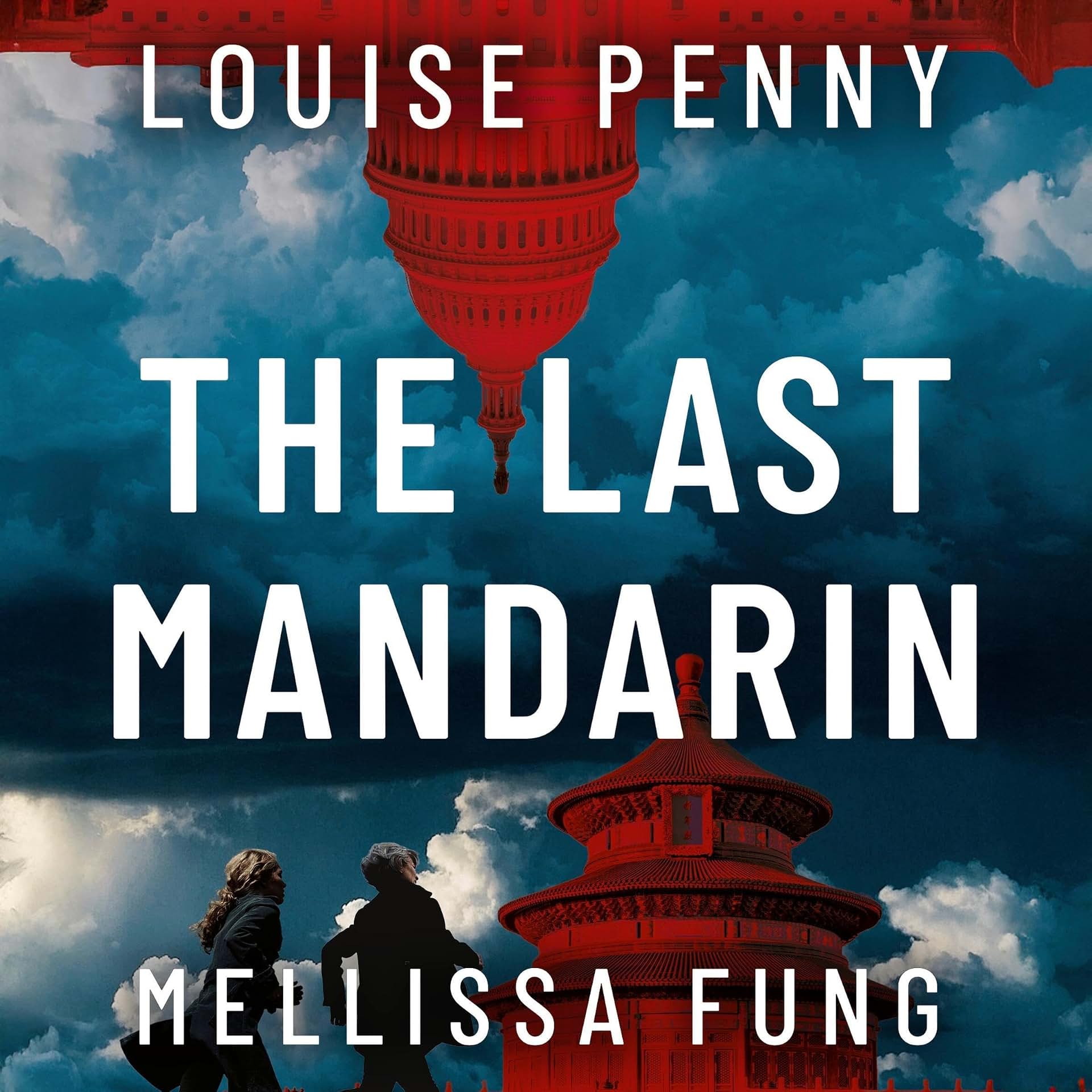
Well, that's beautifully put. And Louise, I just want to give you your flowers and take this time because you've truly built one of the most beloved series in contemporary mystery fiction. And you also have dabbled in co-authoring books with Hillary Rodham Clinton and Melissa Fung, which, by the way, came out this year as well. What's next on your creative horizon? And is there a story you haven't told yet that keeps calling you?
You'd think after 21 books, I would be tired of writing Three Pines and Gamache. I am not. I am not. I love doing that. The collaborations are fun because they're different. I have someone there to blame if something goes wrong, so that's always a good thing (laughs). And it takes me away from where I normally live. Then when I come back, it's like coming home again. I'm back in Three Pines. I'm cresting the hill. I see the mountains of Vermont, and I look down and there's the pretty little village and I'm home again. And that's always such a gift. I mean, there are other things that we're thinking of that I can't really talk about right now, but most of them circling around the Three Pines world.
Well, thank you again so much. I am so grateful to have had this time with you today.
I loved it.
This was so great and beautiful. I just want to say again, please keep the series going. I only want to see more of Armand Gamache. I love his style. He's amazing.
You know what? Fred Molina has signed up for five books, so I have to write at least five.
Yes. Oh, my gosh. You heard it here first, guys. He signed on for five more, so we're going to get more of him. And again, thank you so much, Louise. It was such a great time speaking with you today. This was a wonderful conversation. And for our listeners, you can get Miss Wolcott's Ghost on Audible now.