• Why Your Type Isn’t Your Match : The Psychology of Attraction, Attachment, and Emotional Compatibility
    18 Oct 2026

    Chemistry can be irresistible, but attraction doesn’t guarantee compatibility.

    In this episode of The Same Emotional Structure, Susan Q. takes you inside a Parisian matchmaking agency to explore five psychological relationship archetypes, attachment patterns, and the hidden forces behind romantic attraction.

    Discover the difference between chemistry, emotional compatibility, and building a lasting relationship.

    Find your psychological match!

    Take the free EOS Psychological Compatibility Quiz: https://novelpsyche.com/EOS-Quiz.pdf

    Because someone can be your type without being your match.

    Daha fazlasını göster Daha Az Göster
    24 dk.
  • Choose to Be Respected, Not Just Liked: The Psychology of Assertiveness, Self-Respect, and Becoming Whole
    18 Oct 2026

    Have you ever said yes when everything inside you wanted to say no? How much of your ambition, freedom, and potential have you sacrificed just to be liked?

    In this episode of The Same Emotional Structure, Susan Q. explores the hidden cost of people-pleasing and why choosing self-respect sometimes means disappointing others.

    Through a relatable workplace story and insights from Carl Jung’s shadow integration and Bowen’s differentiation of self, we explore how to set boundaries without guilt, face conflict without fear, and remain kind without sacrificing ourselves.

    Discover why temporary discomfort can lead to lasting freedom, how assertiveness builds healthier relationships, and why true emotional maturity means embracing both your strength and compassion.

    The greatest tragedy isn’t that some people may not like who you become. It’s that you might never become who you could have been because you were too afraid to disappoint them.

    Stop living for approval. Start becoming whole.

    Daha fazlasını göster Daha Az Göster
    20 dk.
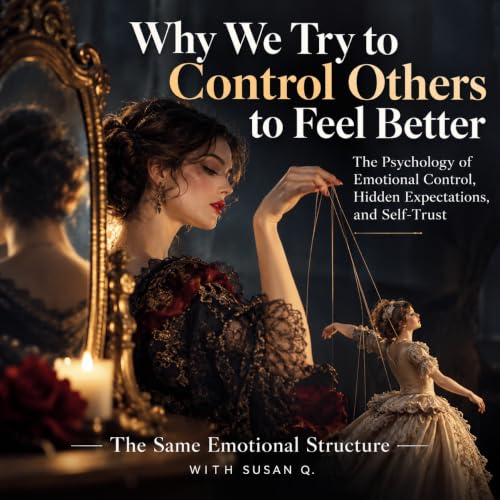
  • Why We Try to Control Others to Feel Better: The Psychology of Emotional Control, Hidden Expectations, and Self-Trust
    14 Oct 2026

    Behind blame, hidden expectations, jealousy, and the need to change someone else’s behavior often lies something deeper: our struggle to manage our own emotional discomfort.

    Inspired by Dangerous Liaisons, this episode explores the invisible psychological games we play to feel safe, loved, and in control.

    Discover why we turn to others to regulate our emotions, how unspoken expectations become emotional contracts, and why self-trust is the foundation of emotional freedom.

    Because real freedom begins when we stop needing others to behave a certain way in order to feel okay.

    Daha fazlasını göster Daha Az Göster
    21 dk.
  • Limerence Without a Relationship: When the Object Is the Feeling
    3 Oct 2026

    Limerence can organize a whole inner life around someone who was never a partner. No anniversary, no key, no breakup. Still, the person becomes the place where hope, aliveness, and a future are stored.

    In this episode of The Same Emotional Structure, Susan Q. looks at what happens when the object of limerence is not the relationship, but the feeling the other person activates. Drawing on Dorothy Tennov, Stendhal’s crystallization, Proust, and attachment theory, the episode traces how fantasy binds a real emotional state to an incomplete bond: loneliness becomes imagined contact, dread becomes anticipation, emptiness becomes a future with their name on it.

    The feeling can be real while the interpretation stays unfinished. The question is not only why they will not leave your mind. It is what the mind is building each time it returns to them.

    Daha fazlasını göster Daha Az Göster
    22 dk.
  • The Hidden Expectation: Why Assertiveness Feels Like Selfishness
    11 Oct 2026

    Why does saying no feel selfish, even when you’re being fair?

    We carry invisible expectations: Be reliable. Be kind. Never disappoint anyone. Always do more.

    Nobody necessarily asks us to follow these rules. Yet we turn them into obligations, until our greatest strengths begin to cost us our freedom.

    In this episode of The Same Emotional Structure, Susan Q. explores why capable people over-function, why we confuse responsibility with obligation, and why we sometimes stay silent for years just to avoid conflict.

    Drawing on Carl Jung’s persona and shadow, Alfred Adler’s courage to be disliked, Buddhist non-clinging, and the Emotional Operating System (EOS), we uncover how hidden expectations shape our identity—and why breaking them can feel like doing something wrong.

    Because assertiveness isn’t about becoming selfish. It’s about discovering that you can be kind, capable, and responsible without abandoning yourself.

    What expectations are you still living by that you never consciously agreed to?

    Daha fazlasını göster Daha Az Göster
    23 dk.
  • Reclaim Your Power: Why Good People Need Their Shadow
    1 Oct 2026

    What happens to the parts of ourselves that don’t fit the person we believe we are?

    The nice person still has aggression. The selfless person still wants things. The strong person still needs comfort. And the person who says I don’t care what anyone thinks may still deeply want approval.

    Using Keigo Higashino’s Malice as a literary frame, this episode explores the architecture of the shadow—how belonging and adaptation shape identity, how disowned feelings can emerge through projection and splitting, and why what we refuse to recognize in ourselves doesn’t necessarily disappear. Sometimes, it simply finds another way to speak.

    Drawing from Jung, attachment theory, Winnicott, Internal Family Systems, and the Emotional Operating System (EOS), Susan explores a different possibility: what if envy became information, aggression became conscious capacity, and approval no longer determined identity?

    Shadow integration isn’t about becoming darker—or expressing every impulse.

    It’s about becoming large enough to hold more of yourself.

    The more of yourself you can consciously hold, the less of yourself you need someone else to carry.

    Not to become perfect.

    To become whole.

    Daha fazlasını göster Daha Az Göster
    15 dk.
  • Why We Stay Until We Suddenly Can’t : The Psychology of Emotional Breaking Points, Hope, and Becoming Yourself
    8 Oct 2026

    Why do we tolerate the same behavior for years, only to reach a breaking point over something seemingly insignificant?

    A marriage survives twenty years of disappointment. A friendship continues through years of unspoken resentment. Then one ordinary moment changes everything.

    But what if the breaking point isn’t when the pain becomes unbearable—it’s when the meaning of staying begins to change?

    In this episode of The Same Emotional Structure, Susan Q explores the hidden psychological processes behind emotional breaking points, sudden detachment, and identity transformation.

    Drawing on attachment theory, Carl Jung’s shadow, Robert Kegan’s identity development, predictive processing, and the Emotional Operating System (EOS), we examine how our past shapes our expectations, how emotional regulation can preserve unresolved patterns, and why we sometimes remain attached to a future that hasn’t arrived.

    We also explore the phenomenon popularly known as the INFJ doorslam—and why what appears to be sudden withdrawal may reflect a much longer internal process.

    At the heart of this episode is one question:

    What happens when the person you’ve become can no longer live by the emotional rules that once kept your relationships together?

    Because growth doesn’t always mean leaving. Sometimes it means learning to stay differently, establish boundaries, or finally recognize what you truly want.

    Sometimes relationships don’t change because the other person becomes different. They change because we can no longer be the person we used to be inside them.

    Daha fazlasını göster Daha Az Göster
    22 dk.
  • The Human Ladder: Why We Compare, Compete, and Need to Matter
    6 Oct 2026

    What happens inside you when someone else moves up?

    A coworker gets promoted. A friend gets chosen. Someone doing the same work receives more. Nothing has been taken from you—and yet, somehow, your own position feels different.

    This episode is not a lecture.

    It’s a game. And you’re playing.

    You’ll enter The Human Ladder and make a series of private choices about rank, recognition, belonging, fairness, power, and desire. There are no correct answers. Nobody will know what you chose.

    But by the final round, your own choices may reveal something surprising:

    What are you really trying to get when you want to move up?

    Drawing on social comparison, social identity, Winnicott, Jung, and The Secret of the Golden Flower, we explore the line between using comparison as information—and allowing comparison to define who we are.

    Because the goal may not be to stop comparing.

    It may be to learn how to look at the scoreboard without letting the scoreboard become your identity.

    Come play. And don’t change your answers.

    Daha fazlasını göster Daha Az Göster
    23 dk.