Bölümler

  • The Bond Market Always Gets the Final Vote
    30 Sep 2026

    The bond market is getting restless. What rising yields, $40 trillion in debt, AI spending, and Scott Bessent reveal about the price of money.

    Bill Clinton famously exploded during a 1993 economic meeting: “You mean to tell me that the success of the program and my re-election hinges on the Federal Reserve and a bunch of f***ing bond traders?”

    More than three decades later, the bond traders are once again getting everyone’s attention.

    My guest on this recent WhoWhatWhy podcast, economist Dean Baker, questions some of the conventional explanations for what’s happening — starting with the alarm surrounding America’s $40 trillion debt. “If we have a strong, growing economy,” Baker argues, “our debt’s not a problem.”


    Get full access to Talk Cocktail Podcast at jeffschechtman.substack.com/subscribe
    Daha fazlasını göster Daha Az Göster
    35 dk.
  • Why We Can’t Outrun Our Own History
    7 Oct 2026

    Michael Moritz, a former journalist, became one of Silicon Valley’s most successful investors — and a philanthropist who has quietly backed the Booker Prize and San Francisco journalism. Yet he never escaped the terror of his family’s past. On this recent California Sun podcast, the longtime Sequoia Capital leader talks about his new book, “Ausländer,” which traces how his family’s flight from Nazi Germany echoes in the lives of descendants who never lived it.


    Get full access to Talk Cocktail Podcast at jeffschechtman.substack.com/subscribe
    Daha fazlasını göster Daha Az Göster
    36 dk.
  • The Gold Rush That Never Ended
    7 Oct 2026

    Nathaniel Philbrick, a National Book Award winner and Pulitzer finalist, recasts the Gold Rush as the moment where America learned to embrace greed and live at warp speed. His new book, “The Rush,” and in our recent California Sun conversation, he explores instant wealth, immigration, slavery, and technological upheaval, then follows that same restless impulse from the Gold Rush through railroads and agriculture to Silicon Valley and the artificial intelligence boom.


    Get full access to Talk Cocktail Podcast at jeffschechtman.substack.com/subscribe
    Daha fazlasını göster Daha Az Göster
    33 dk.
  • AI Is Making Work Sadder: And What Happens When Everyone Shares the Same Brain?
    14 Oct 2026

    What if the most disruptive thing about artificial intelligence isn’t that it takes your job, but that it makes your company indistinguishable from every competitor — and drains the humanity out of the work that’s left?

    Aaron Horwath has an unusual vantage point on that question. As director of AI operations at a creative technology company, his job is to put these tools to work. But in two essays for the longform magazine Noema, published by the Berggruen Institute, he’s become one of the sharpest voices asking how much the corporate rush to “use AI for everything” is costing us as human beings.

    In my WhoWhatWhy conversation, Horwath explains why even senior professionals with decades of experience are feeling a strange career dread. More than fear of unemployment, it involves the loss of something human: the ownership, the craft, the pride in work that was recognizably their own before AI wedged itself into the workplace.


    Get full access to Talk Cocktail Podcast at jeffschechtman.substack.com/subscribe
    Daha fazlasını göster Daha Az Göster
    44 dk.
  • Anand Giridharadas talks to Me About What One Subway Death Reveals About a Country That Stopped Listening
    21 Oct 2026

    Give this country a tragedy and it will have the heroes and villains sorted before the ambulance has pulled away. Americans no longer need to know what happened to know whose fault it is.

    The one reflex a divided country still shares is the certainty that arrives before the facts do.In May 2023, Jordan Neely, homeless and in the grip of mental illness, died in a chokehold on a Manhattan subway, held down by a former Marine named Daniel Penny. Almost before the facts were known, the argument was settled.

    My guest on this recent WhoWhatWhy podcast, Anand Giridharadas, put it this way, they got their group number and went to stand in the right line.

    Giridharadas, a former New York Times correspondent and author of Man in the Mirror: Hope, Struggle, and Belonging in an American City, treats that subway car as a biopsy: a small incision that reveals the condition of the whole body.


    Get full access to Talk Cocktail Podcast at jeffschechtman.substack.com/subscribe
    Daha fazlasını göster Daha Az Göster
    44 dk.
  • The Birth of the Theranos/Holmes Scandal
    24 Oct 2026

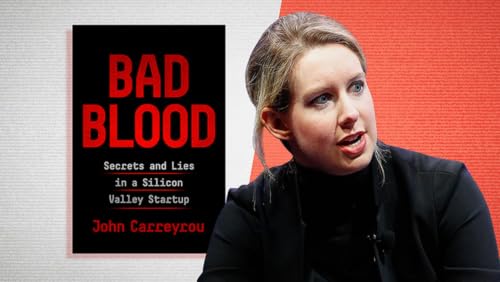
    With all the buzz surrounding You Can See Everything, the new Nathan Fielder documentary about Elizabeth Holmes, it’s worth going back to where the Theranos story began.

    Eight years ago, I spoke with John Carreyrou, the Wall Street Journal reporter who broke the story of Silicon Valley’s spectacular blood-testing fraud. His book, Bad Blood, had just been published. Carreyrou, now at The New York Times, was still uncovering the full extent of the deception.

    Before the trials, the documentaries, and the Hollywood treatment, this was one of the earliest in-depth podcast conversations about the case. A useful primer on how it all began.


    Get full access to Talk Cocktail Podcast at jeffschechtman.substack.com/subscribe
    Daha fazlasını göster Daha Az Göster
    27 dk.
  • Have We Lost Sight of What Politics Is For?
    28 Oct 2026

    Can we defend democracy without sacrificing the friendships and human connections that make it worth saving? The paradox of political obsession.

    In this recent WhoWhatWhy podcast, I talk with political philosopher Roger Berkowitz — founder of Bard College’s Hannah Arendt Center and author of A World We Share: Hannah Arendt and the Power of Friendship in a Broken World. He explores a provocative idea: Perhaps democracy’s survival depends as much on our capacity for friendship as on our political convictions.

    What if one of the greatest threats to democracy isn’t political extremism itself, but the disappearance of the human relationships that make democracy possible? What if, in our determination to defend the country, we’re slowly destroying our ability to share it?

    We live in an age when political convictions increasingly determine whom we trust, whom we love, even whom we’re willing to speak to.

    Outrage has become a measure of moral seriousness, and every disagreement seems to demand a verdict on someone’s character. But is this constant state of political mobilization making us better citizens, or simply making us less capable of living together?


    Get full access to Talk Cocktail Podcast at jeffschechtman.substack.com/subscribe
    Daha fazlasını göster Daha Az Göster
    43 dk.
  • A Timeline of Western Decline
    17 Sep 2026

    Everyone wants to name the moment it all went wrong. Most people name 2016, and one man, and an election they’re sure the next election can undo.

    My guest on a recentWhoWhatWhy podcast, Bianka Banova, says they’re off by decades.

    The disorder people feel now — the cost of living that won’t fall, the wars that won’t stop, the ground shifting underfoot — isn’t the beginning of anything. It’s the moment the water got hot enough to feel. She argues the world came apart slowly, one comfortable choice at a time, beginning with decisions made decades ago.


    Get full access to Talk Cocktail Podcast at jeffschechtman.substack.com/subscribe
    Daha fazlasını göster Daha Az Göster
    58 dk.