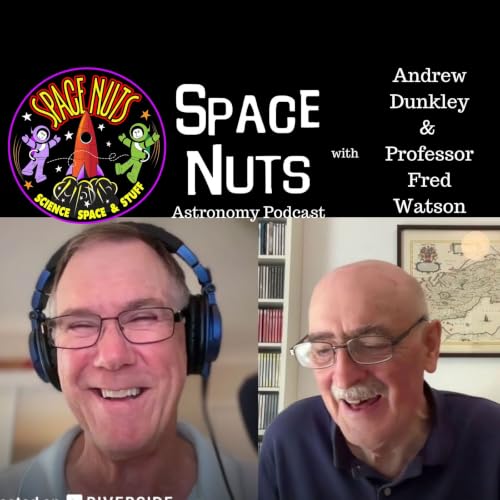
Space Nuts: Astronomy Insights & Cosmic Discoveries kapak görseli

Space Nuts: Astronomy Insights & Cosmic Discoveries

Space Nuts: Astronomy Insights & Cosmic Discoveries

Yazan: Professor Fred Watson and Andrew Dunkley
Şimdi ücretsiz dinle, üyelik gerekmez

This Season's Biggest Deal | £0.99/mo for 3 months + £10 Audible bonus

£5.99/mo after 3 months - terms apply. Cancel monthly
Özet
  • 5 million downloads and counting
  • 90+% Five Star Reviews
  • Hosted by Astronomer At Large, Professor Fred Watson and Sci-Author/Broadcaster Andrew Dunkley
  • 660 Episodes and counting
  • Very active (and friendly) listener community
  • Advertising Free options available.


Become a supporter of this podcast: https://www.spreaker.com/podcast/space-nuts-astronomy-insights-cosmic-discoveries--2631155/support.Copyright bitesz.com
Astronomy Astronomy & Space Science Nature & Ecology Science
  • Rubin’s New Dwarf Planet & Neptune’s Trojan Asteroid: Discoveries on the Solar System’s Edge
    5 Nov 2026
    Space Nuts: A New Dwarf Planet, 3I/ATLAS, and Neptune’s Hidden Trojans
    In this episode of Space Nuts, Andrew Dunkley and Professor Fred Watson explore three discoveries from across the Solar System and beyond. They begin with the Vera C. Rubin Observatory’s discovery of a distant, potentially large dwarf planet, and discuss what its unusual orbit could tell us about the hunt for the elusive Planet Nine. Next, they examine new James Webb Space Telescope observations of interstellar comet 3I/ATLAS, whose unusual chemistry may preserve clues to its origins in a very cold environment billions of years ago. Finally, the hosts turn to Neptune’s long-sought Trojan asteroids, discovered in data from the Rubin Observatory by a team in Belfast. Join Andrew and Fred Watson for distant worlds, ancient cosmic ice and asteroids hiding in the dark.
    Key topics
    - The Vera C. Rubin Observatory’s discovery of dwarf planet candidate 2026 ED138.
    - What makes an object a dwarf planet, and how its orbit could inform the Planet Nine debate.
    - 3I/ATLAS’s unusual isotope ratios, methane and possible origins in an ancient, cold environment.
    - The discovery of Neptune’s Trojan asteroids and why they have been so difficult to observe.
    Timestamps
    00:00 - Introduction and episode overview
    01:20 - The Vera C. Rubin Observatory discovers a new distant dwarf planet
    05:30 - What defines a dwarf planet and how it may eventually be named
    09:00 - The object’s size, unusual orbit and possible relevance to Planet Nine
    12:00 - 3I/ATLAS and its unusual chemistry revealed by the James Webb Space Telescope
    16:00 - Isotope ratios, methane and clues to the comet’s age and origins
    20:00 - Neptune’s Trojan asteroids are finally discovered
    24:00 - How Trojan asteroids share a planet’s orbit and why Neptune’s were hard to find
    27:00 - Closing remarks and where to follow Space Nuts

    Become a supporter of this podcast: https://www.spreaker.com/podcast/space-nuts-astronomy-insights-cosmic-discoveries--2631155/support.
    Daha fazlasını göster Daha Az Göster
    30 dk.
  • The Great Attractor & Saturn’s Rings: Unravelling Cosmic Questions
    2 Nov 2026
    Space Nuts: The Great Attractor, What Makes a Moon, and Life Beneath the Rings
    In this listener Q&A episode of Space Nuts, Andrew Dunkley and Professor Fred Watson tackle a curious collection of cosmic questions. They explain why a crescent Moon can appear alongside the Sun in the morning sky, then explore the Great Attractor: the enormous concentration of galaxy clusters influencing the motion of our Local Group. The conversation turns to a lingering classification puzzle — what exactly makes a moon a moon, and should it have to clear its orbit? Finally, they imagine the view from a rocky world with rings, considering how the rings might look through the seasons, how sunlight would filter through them and what spectacular shadows or eclipses might occur. Join Andrew and Fred Watson for astronomy, imagination and the occasional tractor joke.
    Key topics
    - Why the Sun and a crescent Moon can be visible together in the morning sky.
    - The Great Attractor, the Zone of Avoidance and the Laniakea Supercluster.
    - Whether moons need to be spherical or clear their orbits, and the case of Pluto and Charon.
    - What a ringed planet might look like from its surface, including seasonal changes, shadows and eclipses.
    Timestamps
    00:00 - Introduction and overview of listener questions
    01:20 - Why the Sun and crescent Moon can appear together in the morning
    06:00 - Moon phases and how sunlight illuminates the Moon
    09:30 - Paul’s question about the Great Attractor
    11:00 - The Zone of Avoidance and the Laniakea Supercluster
    16:00 - What defines a moon, and should it clear its orbit?
    20:00 - Binary planets, Pluto and Charon
    23:00 - What it might look like to stand beneath a planet’s rings
    26:00 - Seasonal ring illumination, shadows and possible eclipses
    30:00 - Listener feedback, updates and closing remarks

    Become a supporter of this podcast: https://www.spreaker.com/podcast/space-nuts-astronomy-insights-cosmic-discoveries--2631155/support.
    Daha fazlasını göster Daha Az Göster
    31 dk.
  • Japan’s Phobos Mission & Martian Quakes: Exploring Mars’ Moons, Canyons, and the Search for ET
    29 Oct 2026
    Space Nuts: Mars’ Moons, Martian Quakes, and the Search for ET
    In this engaging episode of Space Nuts, Andrew Dunkley and Professor Fred Watson explore two mysteries from Mars, along with a new effort to listen for signs of life beyond Earth. First, they unpack Japan’s Martian Moons eXploration (MMX) mission, which will study Phobos and Deimos, attempt a landing on Phobos and bring samples back to Earth. The discussion turns to a Marsquake traced to the immense Valles Marineris canyon, offering fresh clues that the Red Planet may still be geologically active. Finally, Andrew and Fred Watson examine Saudi Arabia’s plans for a major astronomical observatory, including a site for Laser SETI detectors searching for brief flashes of possible extraterrestrial communication. Join them for a cosmic tour filled with planetary puzzles, ambitious missions and a little speculation about how aliens might get in touch.
    Key topics
    - Japan’s MMX mission to investigate Mars’ moons and return samples from Phobos.
    - The possible origins of Phobos and Deimos, and the challenges of landing on a world with almost no gravity.
    - A Marsquake linked to Valles Marineris and what it suggests about the planet’s geological activity.
    - Saudi Arabia’s planned observatory and the use of optical Laser SETI detectors in the search for extraterrestrial signals.
    Timestamps
    00:00 - Introduction and episode overview
    01:20 - Japan’s MMX mission and the mysteries of Phobos and Deimos
    06:00 - How the mission will study Phobos and attempt to collect samples
    12:00 - The challenges of landing on Phobos and the planned sample return to Earth
    15:45 - A Marsquake traced to Valles Marineris
    19:30 - What the quake reveals about Mars’ geological activity
    22:00 - Saudi Arabia’s new observatory and the Laser SETI search
    26:00 - How optical detectors could look for signals from extraterrestrial intelligence
    29:00 - Closing thoughts and listener engagement

    Become a supporter of this podcast: https://www.spreaker.com/podcast/space-nuts-astronomy-insights-cosmic-discoveries--2631155/support.
    Daha fazlasını göster Daha Az Göster
    34 dk.
adbl_web_anon_alc_button_suppression_t1
Tüm yıldızlar
En alakalı
Listened for years now. Simply the best of there is in space podcasts. Nice one

Great

Bir sorun oluştu. Lütfen birkaç dakika sonra tekrar deneyin.