How Canadian Markets Work kapak görseli

How Canadian Markets Work

How Canadian Markets Work

Yazan: Amy Xu
Şimdi ücretsiz dinle, üyelik gerekmez

Season's Savings | £0.99/mo for 3 months

£5.99/mo after 3 months - terms apply. Cancel monthly

Most financial content is trying to sell you something. This isn't.

How Canadian Markets Work is a series about the machinery underneath Canadian

finance — how capital actually moves from people who have it to people who need

it, and who takes a cut along the way.

Each episode is about twenty minutes and covers exactly one idea. Not three. One.

Your hosts John and Jane work through it in conversation: John explains how the

structure is built, Jane asks the question you were already thinking and pushes

back when something doesn't add up.

Across the series we cover how markets are organized, who regulates them and

why, the economy behind the prices, bonds and how they're really priced, equities

and how companies raise money, derivatives, reading a company's financial

statements, mutual funds and ETFs and what they cost you, and how it all comes

together in a portfolio.

It's built for anyone who wants to understand the system rather than get tips

about it — people starting to invest, people working in or moving into the

industry, and people studying for Canadian financial licensing exams who want

the concepts explained out loud rather than read off a page.

Everything is grounded in how things work in Canada specifically, with current

sources. Where a rule or an institution has changed recently, we say so.

A note on the voices: the hosts are AI-generated. The scripts are written by a

human, researched from primary sources, and fact-checked before publication.

This podcast is educational content, not financial advice. The hosts are not

registered to advise on securities and nothing here is a recommendation to buy

or sell anything. Speak to a licensed professional about your own situation.

Amy Xu 2026
Economics Education Personal Finance
  • Primary and Secondary Markets (AI Deep Dive) | Canadian Investing
    14 Oct 2026

    Hey! I'd love to hear your thoughts, send me a voice note.

    Ever wondered where your money actually goes when you buy a stock? The answer depends on which market you're in. In this episode, we break down primary markets — where companies raise fresh capital through IPOs — and secondary markets — where investors trade with each other and the company never sees your money.

    Key takeaways:

    - Primary market: your money funds the company (IPOs, new issues)

    - Secondary market: your money goes to another investor

    - Why both markets need each other to function

    - What this means for what it really means to "invest in" a company

    Disclaimer: Educational content only — not financial advice. The hosts are AI-generated. Nothing here is a recommendation to buy or sell anything. Speak to a licensed professional about your own situation.

    Daha fazlasını göster Daha Az Göster
    23 dk.
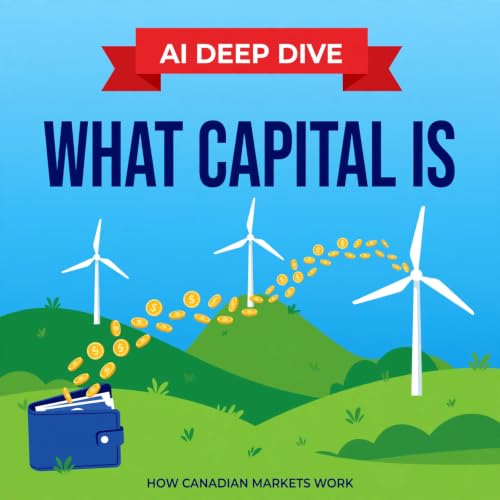
  • What Capital Actually Is (AI Deep Dive) | Canadian Investing
    11 Oct 2026

    Hey! I'd love to hear your thoughts, send me a voice note.

    In this episode, we open up the plumbing of the Canadian financial system: what capital actually is, and how your savings become someone else's funding. We contrast real capital — like a wind farm generating electricity — with financial capital — the stocks and bonds that represent claims on it — and trace the journey from a personal chequing account to a $200 million infrastructure project.

    Key takeaways:

    - Real capital vs. financial capital: one produces, the other represents claims

    - The four hurdles every financial institution exists to solve

    - How savers and users find each other through the system

    - Why idle cash and big projects need intermediaries to connect

    Disclaimer: Educational content only — not financial advice. The hosts are AI-generated. Nothing here is a recommendation to buy or sell anything. Speak to a licensed professional about your own situation.

    Daha fazlasını göster Daha Az Göster
    23 dk.
  • Episode 100: The Financial Planning Process (The Final Finding)
    2 Oct 2026

    Hey! I'd love to hear your thoughts, send me a voice note.

    Episode Summary

    In this grand finale of our hundred-episode journey, we circle back to where we began: the idle four thousand dollars sitting in a personal chequing account and the wind farm two thousand kilometers away seeking two hundred million dollars of capital. While we spent the last ninety-nine episodes analyzing the complex, often invisible machinery that connects savers and users, we deliver an unglamorous but essential truth: investing is only one part of a much larger, six-step financial planning process. Properly understood, financial planning spans cash flow and debt management, insurance, taxation, retirement planning, estate coordination, and education funding. We explain that the portfolio exists to serve these broader life goals, rather than functioning as an end in itself. Optimizing asset location or chasing marginal tax efficiencies is mathematically pointless for an investor who has failed to establish a basic cash emergency fund, holds expensive high-interest debt, or lacks adequate disability insurance to protect their single largest asset—their human capital.

    We trace how the identical core principles of finance must produce completely different strategic answers as an individual progresses through the four distinct phases of the financial life cycle:

    • Early Career: Characterized by low financial assets but peak human capital—representing decades of future earnings. At this stage (illustrated by a twenty-five-year-old renter earning $60,000 with student debt), the absolute priority is establishing an emergency fund, executing a structured debt repayment strategy, and capturing any available employer pension matches. Simplicity is the dominant feature here; the basic, low-cost structure that a saver can stick to with automated, consistent contributions is vastly superior to a theoretically "optimal" portfolio they ultimately abandon. Furthermore, we warn why young savers in lower tax brackets should deliberately carry forward their RRSP contribution room to higher-earning years rather than rushing to claim the deduction immediately.
    • Accumulation: The peak earning years where investors face competing demands, including mortgages, raising children, funding RESPs, and managing aging parents. This is the phase where strategic asset allocation and tax-efficient asset location do the vast majority of their wealth-building work.
    • Pre-Retirement: As human capital rapidly declines and financial assets peak, the risk profile of the entire wealth ecosystem completely inverts. The primary threat shifts from long-term market volatility to sequence of returns risk, where a severe market decline immediately before or after retirement can permanently damage a portfolio's longevity.
    • Decumulation: The transition from contributing to withdrawing capital. In this highly technical phase, retirees must manage longevity risk, navigate mandatory annual RRIF minimum liquidation schedules, and optimize their withdrawal order across registered and taxable accounts to minimize their effective marginal tax rates and prevent clawbacks on income-tested government benefits.

    Finally, we look back at the overarching posture of this show. Over a hundred episodes, we have scrupulously declined to offer individual stock tips or tell listeners what to do. Instead, on every highly contentious economic and market issue—from government deficits and foreign asset ownership to banking concentration, quantitative easing, and dual-class share structures—we have explained the underlying financial mechanisms, presented the range of serious professional opinion, and stopped. This restraint is our credential.

    Daha fazlasını göster Daha Az Göster
    22 dk.
adbl_web_anon_alc_button_suppression_t1
Henüz yorum yok