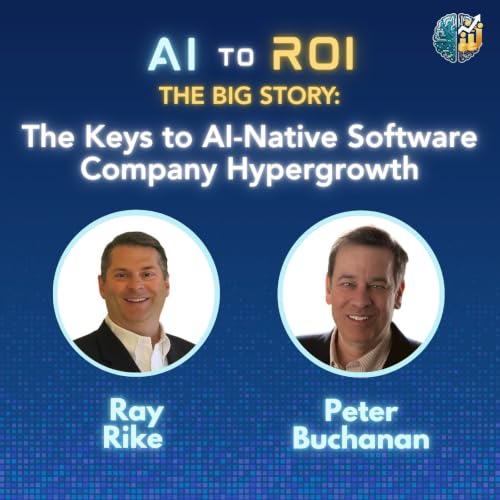
Companies have AI spend tracking in place, but very few can forecast it. In this Big Story episode of AI to ROI, Ray Rike and Peter Buchanan walk through the October 13 newsletter, “The Quest to Create an Auditable, Trackable, and Accurate AI Budget.” The discussion draws on Benchmarkit’s research with Mavvrik covering 396 organizations, which was recently cited by the Wall Street Journal and Apollo.
The headline finding is that tracking is not the same as forecasting. Nearly every company tracks AI infrastructure costs, yet only 11% forecast AI spend within 10% accuracy, and more than half miss by over 26%. The miss affects the business directly. 62% of respondents say unexpected AI costs materially changed a business decision in the past year, about one in four stopped an initiative, and 48% of companies that embed LLMs in their products had to raise prices.
Ray and Peter cover the budget overruns at Uber, Rippling, and Amazon, along with the shared pathologies behind them: misaligned incentives like token maxing, usage that went unforecasted and untracked, and no measurable ROI. They also share results from their own model test.
A model that cost $0.15 per attempt ended up costing almost $57 per completed task once failures, retries, and human rework were included.
Key Takeaways
- Tracking is not visibility: Most companies see spend at a summary level, but only about a third track the cost of the agents they have in production, and 46% have no real-time alerting for overruns.
- Six cost layers: A full AI budget covers tokens and inference, AI infrastructure, agents, AI management applications, labor, and the growing verification tax.
- Price the finished task, not the attempt: Completion rates, retry multipliers, and human rework drive total cost far more than list token prices do.
- A six-step CFO framework: Calculate the full cost of a finished task, trace every dollar to an owner through chargebacks, set guardrails and automatic stops, govern workflows rather than people, and audit invoices every quarter.
- The verification tax is real: In a survey of 6,000 senior executives, 90% saw no measurable AI productivity impact, in large part because of the labor needed to review and correct AI output.
The bottom line: measure AI cost at the most granular level possible, and always tie that cost to the economic value of the outcome.
See Privacy Policy at https://art19.com/privacy and California Privacy Notice at https://art19.com/privacy#do-not-sell-my-info.


 29 dk.
 19 Nov 202638 dk.
 12 Nov 202640 dk.
 28 dk.
 30 dk.
 35 dk.
 32 dk.
 36 dk.