

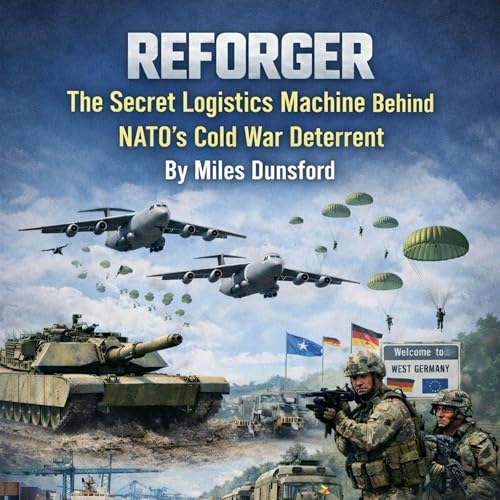
REFORGER
The Secret Logistics Machine Behind NATO’s Cold War Deterrent
Ürünler eklenemedi
Sepete ekleme başarısız oldu.
İstek Listesine ekleme başarısız oldu.
İstek listesinden kaldırma başarısız oldu.
Kütüphaneye ekleme başarısız oldu
Podcast takip edilemedi
Podcast takibi bırakma başarısız oldu.
Standard'ı 30 gün ücretsiz edinin

REFORGER
12,54£ karşılığında satın al
-
Seslendiren:
-
Erin B Clark
-
Yazan:
-
Miles Dunsford
The Cold War is often remembered as a contest of missiles, rhetoric, and nuclear brinkmanship. But beneath the headlines, another kind of power quietly held Europe together. It wasn’t glamorous. It didn’t roar across television screens in columns of tanks or dramatic speeches. It lived in schedules, shipping routes, fuel calculations, rail timetables, warehouse inventories, and the disciplined precision of men and women who understood a hard truth: deterrence is only credible if you can move.
That hidden power had a name: REFORGER. Return of Forces to Germany.
On the surface, REFORGER was an exercise. In reality, it was one of NATO’s most important strategic machines—an annual proof that the alliance could reinforce West Germany fast enough to survive the opening shock of a Warsaw Pact assault. NATO feared that if war ever came, it would come quickly: a sudden surge of Soviet-led mass, designed to break through before reinforcements could arrive, and to present the West with an irreversible fait accompli. The Warsaw Pact had proximity on its side. NATO had distance. And in a war measured in hours, distance could be fatal.
REFORGER existed to remove that vulnerability. It was designed to answer the most dangerous question of the era: could the United States actually show up in time?
This book takes you inside the vast, tightly coordinated system that made the answer believable. It explains how REFORGER evolved from concept to annual reality, and why its success mattered as much as any missile deployment. It breaks down the “Return of Forces” plan—rapid airlift of troops, fast reception in Europe, and the race to become combat-ready before the front collapsed. It explores the strategic brilliance of POMCUS, the pre-positioned equipment sites that stored American tanks, artillery, and armoured vehicles on European soil, maintained year-round and waiting for soldiers who would arrive by air.
©2026 Deep Vision Media t/a Zentara UK (P)2026 Deep Vision Media t/a Zentara UKSeriye devam et


Dinleyici bu eseri ücretsiz aldı
Invisible Army Moves
Bir sorun oluştu. Lütfen birkaç dakika sonra tekrar deneyin.
Dinleyici bu eseri ücretsiz aldı
Preparation Wins Peace
Bir sorun oluştu. Lütfen birkaç dakika sonra tekrar deneyin.
Dinleyici bu eseri ücretsiz aldı
Cold War Logistics Finally Made Interesting
Bir sorun oluştu. Lütfen birkaç dakika sonra tekrar deneyin.
Dinleyici bu eseri ücretsiz aldı
The sections about POMCUS sites and rapid deployment were especially memorable because they revealed how much planning and coordination went on behind the scenes during the Cold War. I also liked that the book gave attention to the people managing these enormous logistical operations, not just the generals and politicians. It’s a thoughtful reminder that deterrence depended as much on organization and preparation as it did on weapons.
Detailed Without Being Overwhelming
Bir sorun oluştu. Lütfen birkaç dakika sonra tekrar deneyin.
Dinleyici bu eseri ücretsiz aldı
One of the strongest elements is the author’s ability to create tension from operational details. Rail schedules, airlift coordination, fuel supply chains, equipment depots, and mobilization exercises might not sound dramatic on paper, but the book explains why every delay or miscalculation could have had catastrophic consequences if war had actually broken out. The constant awareness that NATO was racing against time gives the narrative an almost suspenseful quality throughout.
An Excellent Exploration of the Machinery Behind D
Bir sorun oluştu. Lütfen birkaç dakika sonra tekrar deneyin.